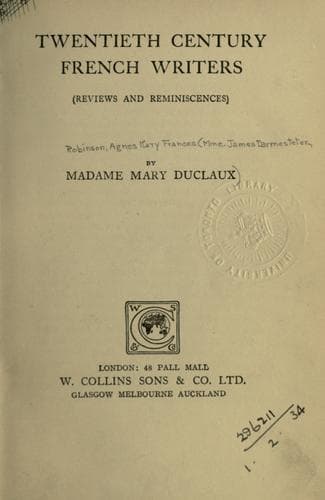
Twentieth Century French Writers: Reviews and ReminiscencesRobinson, A. Mary F. (Agnes Mary Frances)
History
Twentieth Century French Writers: Reviews and Reminiscences
Robinson, A. Mary F. (Agnes Mary Frances)
French literature -- 20th century -- History and criticism
This quiet little girl, at once artless and disenchanted, pious and
disillusioned, does not answer in the least to the conception that a
young German artist forms of France. But we know better! The little
governess personifies that France, known to few outside her boundaries,
which is compact of sacrifice, of duty, of delicate conscientiousness,
of rigid economy for self and generous outlay for some treasured ideal,
child, or cause:--the France of Port-Royal, the France of ‘48. Indeed,
if we mistake not, Mademoiselle Antoinette Jeannin has misspelt her
name; and we envy the novelist who (annihilating time and space) can
link the mind of Beethoven to the soul of Henriette Renan, and make two
lovers happy.
It is true that Romain Rolland will not let them be happy: Antoinette
dies; and Christophe embarks afresh on innumerable adventures. One
first of May, in a Socialist riot, his friend, Olivier Jeannin is
killed on a barricade; and Christophe, red-handed, is spirited away
by his friends, and takes refuge in Switzerland. What an arraignment
of the civilisation of Bâle! Give us rather the incoherence of
German militarism mixed with German _schwärmerei_! Steep us in the
intellectual and social extravagances of France! But keep us free from
that death-in-life, the Phariseeism of Bâle! A rigid discipline never
relaxed; a collective conscience ever on the watch to punish and deride
the faults of individuals; a perpetual constraint in which diversity
and spontaneity perish; all the virtues--without the grace of God! And
underneath the strict uniformity of its phylacteries, human passions
more brutal than elsewhere, because never visited by the open air and
sun. As we read the description of Christophe’s life in Switzerland,
we fall in love with Bohemia. Order is only lovely when it is tempered
with grandeur or with grace. But the order of these sordid millionaires
is merely a morose economy, a gloomy, dull privation, a lifeless
rigour, a sombre constraint. Against this dark background, Romain
Rolland projects a figure of almost animal passion.
The story of Jean-Christophe in Switzerland is the history of Wagner
and Mathilde Wesendonk. In either case a German musician, fleeing from
political difficulties, takes refuge (and takes refuge in Bâle) with a
friend who generously comes to his rescue; and in return the musician
seduces the wife of his protector.
We know little of the Wesendonks, save that Frau Mathilde was a
poetess; I imagine her very different from the wife of Doctor Braun.
That kind, fussy little man was oddly mated with the stiff and silent
spouse whose large, Michael-Angelesque type of beauty seemed almost
ugly or ridiculous in her awkward provincial clothes. Anna is an
uninteresting but perfectly virtuous woman until Jean-Christophe
comes to stay in her house. And then music invades her with an
incomprehensible passion, turning this sombre young Hausfrau into an
imperious Venus.
Public-domain text, read in full here on John Shaqi.
Reviews
Reviews
No reviews yet
Be the first to share your thoughts on this work.
Join the Discussion
Join the discussion
Sign in to leave a comment or review.
Sign InorCreate an account