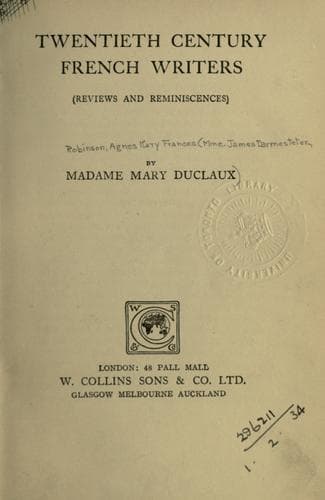
Twentieth Century French Writers: Reviews and Reminiscences — John Shaqi
Twentieth Century French Writers: Reviews and ReminiscencesRobinson, A. Mary F. (Agnes Mary Frances)
History
Twentieth Century French Writers: Reviews and Reminiscences
Robinson, A. Mary F. (Agnes Mary Frances)
French literature -- 20th century -- History and criticism
As she and Christophe sing together the fiery phrases of his Opera,
a frenzy overcomes them, and they experience that sort of love in
which there is something savage, cosmic, as far as possible removed
from our ideas of tenderness or duty. And Christophe, the faithful
Christophe, steals from his generous host that little treasure of
honour and domestic happiness which was all that Dr Braun had known of
life’s ideal. Christophe had been received under that roof in his dire
necessity, and he betrayed a trust. With a woman whom he barely knew,
whom he did not pretend to understand, whom he did not love. Not love?
Love was too weak a work to express the torrent of flame that tortured
the musician when he thought of Anna or listened to her voice; and
yet he was dimly aware that this fierce instinct, this irresistible
intuition, was something less, or more, than human: _Ce n’était pas
l’amour, et c’était mille fois plus que l’amour_.
Thus in the Swiss town, in the Calvinist society, which glorified
rationalism and made of Intellect the sole motive power of life,
Christophe encountered, and was conquered by, that great irreducible
Force which makes light of reason and morality, and in front of which
all our laws and our scruples and our duties are as idle straws caught
in the swirl of a river in flood.
But the strength of that fragility, which is Man, lies in his power
of recovery. Like the prodigal son, having fed with the swine, he can
always return and go to his Father. Christophe, like Maggie Tulliver
in George Eliot’s novel, sets duty and faithfulness above passion, and
ascends out of the abyss.
‘Il comprenait la vanité de son orgueil, la vanité de l’orgueil
humain, sous le poing redoutable de la Force qui meut les mondes.
Nul n’est maître de soi avec certitude. Il faut veiller. Car si
l’on s’endort, la Force se rue en nous et nous emporte ... dans
quels abîmes? Ou le torrent qui nous charrie se retire et nous
laisse dans son lit à sec. Il ne suffit même pas de vouloir, pour
lutter. Il faut s’humilier devant le Dieu inconnu qui _fiat ubi
vult_, qui souffle quand il veut, où il veut: l’amour, la mort ou
la vie. La volonté humaine ne peut rien sans la sienne. Une seconde
lui suffit pour anéantir des années d’efforts. Et, s’il lui plait,
il peut faire surgir l’éternel de la poussière et de la boue.’
Jean-Christophe sacrifices his delight to his ideal of conduct. He is
rewarded by a great influx of inspiration. In solitude and renunciation
he takes up his abode on the edge of a mountain, in the shelter of
great woods full of shadow and loneliness; and he lives there in
retreat and penitence, hearing nothing of Anna. And, even as Wagner in
his exile at Venice, when he had renounced Madame Wesendonk, composed
_Tristan und Isolde_, Jean-Christophe receives at last his inspiration
as a great musician.
Public-domain text, read in full here on John Shaqi.
Reviews
Reviews
No reviews yet
Be the first to share your thoughts on this work.
Join the Discussion
Join the discussion
Sign in to leave a comment or review.
Sign InorCreate an account