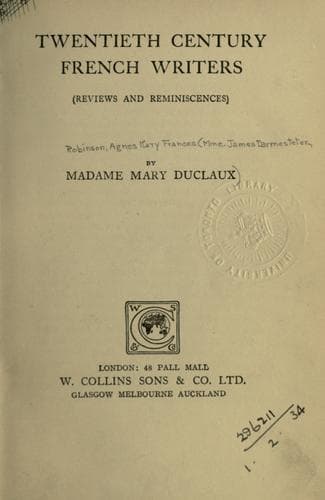
Twentieth Century French Writers: Reviews and ReminiscencesRobinson, A. Mary F. (Agnes Mary Frances)
History
Twentieth Century French Writers: Reviews and Reminiscences
Robinson, A. Mary F. (Agnes Mary Frances)
French literature -- 20th century -- History and criticism
Jean-Christophe was a man of yesterday. His creed was to think no lie,
to consent to no injustice, and to love his neighbour as himself. Here
M. Rolland shows him in his puissant and solitary decline, dominating
a new generation that rises round his knees, strangely different, with
other ideals. Truth? Humanity? The old-fashioned words are rarely
heard. We hear of Authority, of Order, of the claims of one’s race, of
the rights and responsibilities of the strong. This new generation,
which has witnessed no war, has the mind and disposition of conquerors.
Christophe surveys with tender ironical affection the lovable breed
of airmen, and sportsmen, and soldiers who fill France to-day--fresh,
and frank, and admirably valiant, full of prompt physical courage and
intellectual docility.
_Jean-Christophe_ is perhaps the most remarkable work of contemporary
fiction: a singular moral fervour, a rare imagination, an unequalled
sensibility, a torrent of sarcasm, rancour, revolt, tenderness,
stream from its disconcerting pages. But these delicate notations
of minute variations in sensibility, though infinitely precious to
the psychologist, transgress the limits that strict art prescribes.
Romain Rolland sacrifices every grace of measure and composition to
his abundance, to his enthusiasm for Life. He has no sense of style.
His endless files of short, breathless sentences succeed each other
interminably, with no variation, till we experience at last the
sensation of a drop falling at regular intervals on the crown of our
head! He has been called ‘un volcan qui ne vomit que des cendres.’ And
then the rare flame strikes out--passages of infinite tenderness or of
solemn grandeur.
Still, let me own, while I admire _Jean-Christophe_, I think sometimes
with regret of a Turgeneff, no less subtle, who composed his novels
at a like tremendous length, and then, pen in hand, went through his
manuscript again, and reduced it by two-thirds.
When we open by chance one of those old novels, still famous, long
unread, which nourished the minds of our ancestors--_Clarissa Harlowe_,
_La Nouvelle Héloise_, or _L’Astrée_, or _Amadis_--or any other of
those immense, untidy romances, vast bazaars or stores of their age,
which provided several generations with every necessary of life, we
are nearly always astonished to find them so interesting and so good.
Our forefathers were no fools: what they loved in these books, which
were for them a school of feeling, was not Art, but Life. Nothing is
more instructive in this connection than to read a letter of Mme de
Sévigné’s on the interminable masterpiece of La Calprenède; the great
lady, so delicate, so difficile, ‘blessée des méchants styles,’ can
scarcely understand her own enthusiasm:--
Public-domain text, read in full here on John Shaqi.
Reviews
Reviews
No reviews yet
Be the first to share your thoughts on this work.
Join the Discussion
Join the discussion
Sign in to leave a comment or review.
Sign InorCreate an account