Twentieth Century French Writers: Reviews and Reminiscences — John Shaqi
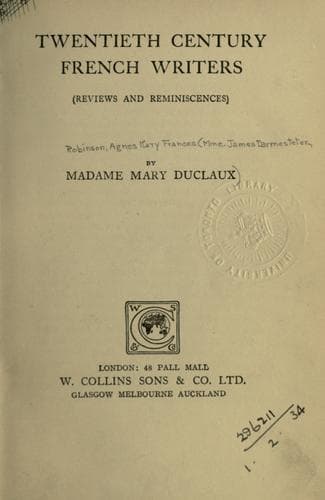
Twentieth Century French Writers: Reviews and ReminiscencesRobinson, A. Mary F. (Agnes Mary Frances)
History
Twentieth Century French Writers: Reviews and Reminiscences
Robinson, A. Mary F. (Agnes Mary Frances)
French literature -- 20th century -- History and criticism
And I should have liked for him the death of Péguy--defending his
country--leading his men into battle on the Marne--Ah! there’s the rub!
Jean-Christophe was an enemy-alien; he would have been fighting in the
Prussian ranks. For many years to come M. Rolland’s hero cannot be our
hero.
A reader appreciative of the intentions of M. Rolland might have been
sure than Jean-Christophe would die in no such picturesque or dramatic
fashion, but quietly yield his life on the brink of a new world, as a
wave effaces itself gently and vanishes in the sand, obliterated by the
pressure of the oncoming wave.
The whole meaning of M. Rolland’s book is the continuity of Life,
spreading insensibly from soul to soul, from sphere to sphere, in an
endless symphony. And the last chapters are full of new characters,
pushing forward, rising to maturity; children of the Past in whom the
dead revive, fathers of the Future who already are changing the face of
our world. The scheme of _Jean-Christophe_ (rising thus, and falling,
and rising at the end towards the yet unvisioned spectacle of times
about to be) recalls the structure of Tolstoi’s _War and Peace_.
Jean-Christophe succumbs, sordidly enough, in a Paris lodging, to
pneumonia. But he gives up the ghost in a mood of heroic joy, thankful
to exchange the worn-out faculties, the dreary, dingy end of life,
which are all he can dispose of here, for some undreamed-of harmony
and power which await him (as he believes) beyond. Tolstoi himself has
not a serener conviction that Life extends illimitably around our tiny
sphere, bathing the shores of all the stars in a tide of continual
renewal. The unity of the forces which compose a living being must
sooner or later dissolve, but the processes of Infinity will reassemble
them again. ‘Un jour je renaîtrai pour de nouveaux combats!’ Meanwhile,
caught in a rapture beyond the delusion of self, the dying musician
feels his personality expand and vanish for a while in something
vaster. He is lost in the One-and-All. ‘Tu renaîtras.... Repose. Tout
n’est plus qu’un seul cœur.’
And so Jean-Christophe greets a new dawn and leaves behind him, also,
on earth a new day. The finest passages of this last volume contain
M. Rolland’s masterly portrayal of the young France of our times.
Surely never was there a generation more unlike its introspective,
intellectual forbears: Hamlet has given birth to Harry Hotspur! We must
perhaps go back to the times of Ausonius (when the fathers were readers
of Seneca and Cicero and the sons hardy Christian barbarians) to find
two generations similarly contrasted.
Public-domain text, read in full here on John Shaqi.
Reviews
Reviews
No reviews yet
Be the first to share your thoughts on this work.
Join the Discussion
Join the discussion
Sign in to leave a comment or review.
Sign InorCreate an account