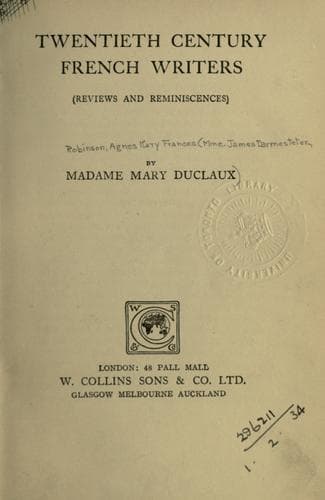
Twentieth Century French Writers: Reviews and ReminiscencesRobinson, A. Mary F. (Agnes Mary Frances)
History
Twentieth Century French Writers: Reviews and Reminiscences
Robinson, A. Mary F. (Agnes Mary Frances)
French literature -- 20th century -- History and criticism
His attitude has been one of irritable self-defence. First of all that
pamphlet, ‘Au dessus de la Mêlée’--and now this new book, published
to-day (April, 1919), but finished (M. Rolland tells us) in May, 1914.
_Colas Breugnon_ is a study in Rabelais’ vein. But, if M. Rolland’s
style is far from perfect when he writes as from the Twentieth Century,
what an exasperating gallimaufry it becomes, what a pretentious farrago
of lyrism, puns, blank-verse, conceits, and quips, when he assumes the
character of one of his ancestors; a certain joiner and cabinet-maker
at Clamecy, under the reign of Louis XIII. The rough jokes of the
tavern chronicled in the style of Euphues! Romain Rolland maundering
of Women, Wine, and Song! The worst of it is that his boozing and his
babble do not seem genuine: the professor’s gown peeps from under
the starched blue folds of the carpenter’s blouse. It is as though,
irritated by the reproach of internationalism and cosmopolitanism,
M. Rolland had said to himself, ‘After all, I am neither a Jew nor a
foreigner! If Péguy came from Orleans, I come from Clamecy; I have
just as good French blood in my veins as he.’ And behold him capering
unconvincingly as a Burgundian artisan, drowning his troubles in the
bowl.
I wonder if any of my readers remember a French country novel called
_Le Moulin du Frau_, which appeared about 1894, by Eugène le Roy, the
author of _Jacquou le Croquant_. Here is the novel which M. Rolland
has tried to write. It is just the life, day by day, of a miller
in Périgord--a man of strong political feeling, a democrat and a
philosopher on his way, like Colas Breugnon. But the miller of the
Frau, though rustic and plain-spoken, is _not_ coarse, for his author
lived all his life amid the peasants of Périgord and Quercy. The French
peasant has his faults; he loves to excess his money and his land; but
as a rule he is not coarse. I have known a great many, in the country,
and, since the war, in hospital; but for coarseness commend me to the
country folk of Zola, the man of letters; or those of the author of
_Nono_, who is a schoolmaster; or these rowdy village folk of Romain
Rolland’s. They lay the rustic varnish on too thick. Beneath this
vulgar varnish we discern an image sufficiently touching and quite
in Romain Rolland’s stoical vein: That of an obstinate, obdurate,
wine-bibbing, and free-loving old cabinet-maker, besotted with his
love of art and liberty, who in the end, having lost his savings,
his home, his wife, his sculptured treasures, finds himself happier
than he ever was before (though bedridden, poor, and a pensioner in
his children’s bounty) because he has conquered the only liberty that
really matters--the freedom of the soul.
Public-domain text, read in full here on John Shaqi.
Reviews
Reviews
No reviews yet
Be the first to share your thoughts on this work.
Join the Discussion
Join the discussion
Sign in to leave a comment or review.
Sign InorCreate an account