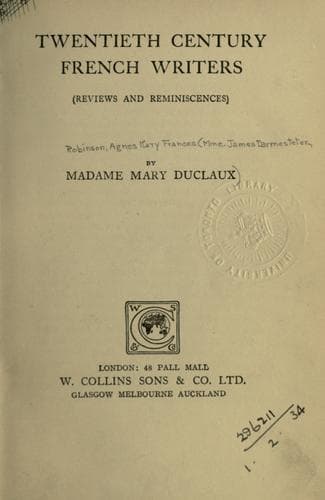
Twentieth Century French Writers: Reviews and ReminiscencesRobinson, A. Mary F. (Agnes Mary Frances)
History
Twentieth Century French Writers: Reviews and Reminiscences
Robinson, A. Mary F. (Agnes Mary Frances)
French literature -- 20th century -- History and criticism
It is impossible to suppose that _Colas Breugnon_ will mark the close
of M. Rolland’s career. It is evidently a caprice, a _boutade_, an
interlude. In what sense will his talent now develop? His years have
just completed their half-century, but he still has some good autumns
before him: Cervantes was turned fifty-seven when he published the
First Part of _Don Quixote_!
To return to our Twentieth Century writers, Rostand stands the next
upon our list. The war has neither augmented nor diminished Rostand.
The few occasional poems that he published during its course are of
slight importance; one imagines him following the tragic struggle with
an attention so deeply engrossed that he half-forgot to breathe, and
could not sing. When Victory promised us Peace, the strain relaxed.
The fragile enthusiast could draw a deep breath. It was his last. He
died, after a brief illness, a few weeks after the conclusion of the
Armistice.
Let us turn the page again. Paul Claudel has written a few more
dithyrambs in prose, but these five years have increased the volume
without changing the character of his work. He is still predominantly
the author of the _Cinq Grandes Odes_, of _L’Otage_, of _La Jeune
Fille Violaine_, all published some years before the war. He serves
his country as Consul in Brazil instead of at Hamburg; still in the
full strength of his years, with doubtless other laurels to conquer, he
stands out, among the ranks of our writers, a creature of passion and
combat, active, emotional, mystic, and material at once--adequate to
his age.
Francis Jammes, too, is unchanged, save by the natural process of the
years. The Faun turned Friar is now more and more an author for the
family circle. He is a candidate to the French Academy, which has just
received his successor on our list, René Boylesve. This last writer,
at least, has been deeply touched by the war. His fine novel, _Tu N’es
Plus Rien_, will remain as evidence of that passionate patriotism--that
detachment from all individual interests and, I might almost say, that
cessation of all individual existence which made the France of the
Great War as rapt, as ecstatic an example of the force of a collective
sentiment as the France of the Great Revolution.
Public-domain text, read in full here on John Shaqi.
Reviews
Reviews
No reviews yet
Be the first to share your thoughts on this work.
Join the Discussion
Join the discussion
Sign in to leave a comment or review.
Sign InorCreate an account