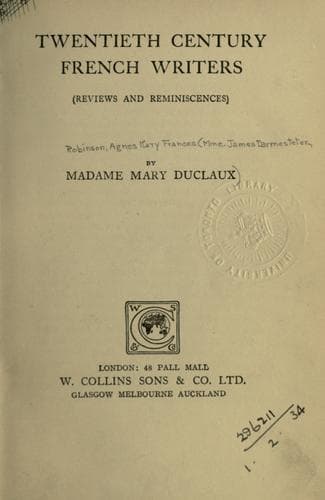
Twentieth Century French Writers: Reviews and ReminiscencesRobinson, A. Mary F. (Agnes Mary Frances)
History
Twentieth Century French Writers: Reviews and Reminiscences
Robinson, A. Mary F. (Agnes Mary Frances)
French literature -- 20th century -- History and criticism
And now (after a passing glance at an unchanged, inconspicuous André
Gide) we approach the name of Péguy. Péguy was killed in September,
1914, as he was leading his men into action at the Battle of the Marne.
And as the flash of a fusee lights up the nocturnal battlefield, so
that tragic illumination of his death reveals the true meaning of much
that was obscure and easy to misunderstand in his gift. I own that I
have almost entirely rewritten the chapter I had given to Péguy. I did
not--do not--fully like or appreciate a genius now generally accepted
as such in France, but I had composed my first sketch in a mood of
freakish pleasantry, which might be permitted towards a man much
younger than myself, with a great future before him, but which is not
possible in speaking of a poet, dead, who died a martyr and a hero. It
is perhaps the fault of a classical education which, if it was not very
extensive at least sank deep, (inclining me especially to grace and
measure, to something exquisitely right, exactly true)--it is perhaps
the fault of a taste nourished on Sophocles and Plato that these
ultra-lyrical modern geniuses, with their wild reiterations, their
violence, their volume, their hoarse abundance, more often shock or
dazzle me than please.... Péguy, Claudel, carry me off my feet, drown
me, drench me in their billows full of sand and pebbles, and leave me
gasping: ‘Oh, for the well beneath the poplar in the field!’ Yet Péguy
and Claudel are the names which must be most profoundly considered in
this little book, for they represent a generation. I have placed in
Péguy’s train, as witnesses and mourners, his friend Ernest Psichari,
his fellow-officer, Émile Nolly, and the two really considerable
writers who have risen into eminence during the war: Henri Barbusse and
Georges Duhamel.
Three of our four ladies have passed through the time of stress
unscathed nor greatly left their impress on the angry world--not that
they have not published in due course their poems or their novels.
But these novels and poems are chiefly reflections from a mirror
fully occupied by their own image. Madame Colette publishes to-day
_Mitsou_; the tender irony and charming grace of her style are the same
as of old--Mitsou is an enchanting little savage of the music-hall
stage--Madame Tinayre has given us a novel which is an agreeable fresco
of the day of mobilisation in Paris. Madame de Noailles has scattered
a score of lyrics, like a handful of rose leaves and cypress-buds,
over the pages of half a dozen reviews, but the terrible enigma--‘Must
I grow old like the others? And, if not, must I die?’ is her most
intimate preoccupation, and blurs in her eyes the great spectacle of
the war.
Public-domain text, read in full here on John Shaqi.
Reviews
Reviews
No reviews yet
Be the first to share your thoughts on this work.
Join the Discussion
Join the discussion
Sign in to leave a comment or review.
Sign InorCreate an account