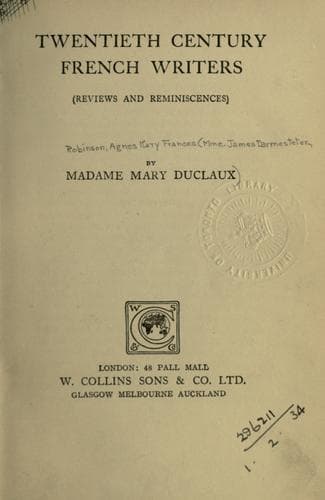
Twentieth Century French Writers: Reviews and ReminiscencesRobinson, A. Mary F. (Agnes Mary Frances)
History
Twentieth Century French Writers: Reviews and Reminiscences
Robinson, A. Mary F. (Agnes Mary Frances)
French literature -- 20th century -- History and criticism
Péguy is a great prose writer, a wonderful wielder of image and trope,
a master juggler with all the intricacies of French syntax. And the
nation which produced Agrippa d’Aubigné, Pascal, Voltaire, has always
loved the prose of a brisk polemic. The prose works of Péguy are due
to polemics. And he lays into his enemy with a dexterity, a surety, a
variety of attack unrivalled--here a shower of swift and sudden blows,
there a slow and paralysing envelopment of the adversary. Péguy is an
incomparable wrestler.
For the rest, shall we say that Péguy was the Walt Whitman of France?
Shall we translate him into English under the name of Carlyle--or even
W. E. Henley? There was something of all of them in the irascible,
quizzical, and lovable idealist whose life was one long struggle
against conventional standards and a conventional style; against
middle-class prosperity, modern commodities (generally ‘tout le confort
moderne’); against the preferences of a well-to-do democracy; against
also, and no less, Parliamentary ideals; documentary historical methods
and culture; and, compendiously and inclusively, all that is political
as opposed to mystical, all that is temporal as opposed to spiritual,
all that is matter as opposed to soul, all that is personal as opposed
to general, and, one may add by extension, all that is rich as opposed
to all that is honourably, contentedly, and modestly poor.
With these dispositions it is natural that Péguy should have begun
life as a Socialist. Born of humble stock in 1874 (on those prosperous
banks of Loire where the humblest have all things pleasant and comely
about them, and are themselves men of a slow, wise wit and kindly
culture) Péguy rose from class to class, from board school to training
college, until at twenty he found himself at the University of Paris,
one of the future glories of the École Normale. In the old house of
the Rue d’Ulm he wrote his first poem, _Jeanne d’Arc_ (for already
this son of Orleans was possessed by the memory of the Maid), of which
the singular dedication reflects not only his young ideas of fraternal
democracy, but that extraordinary tide-like style, creeping on inch by
inch, wave by wave, until it submerge the whole ground of the matter,
which Paris, in later days, was so often to admire, to praise, or to
deride:--
‘À toutes celles et à tous ceux qui auront vécu,
À tout celles et à tous ceux qui seront morts pour tâcher de porter
remède au mal universel;
En particulier,
‘À toutes celles et à tous ceux qui auront vécu leur vie humaine,
À toutes celles et à tous ceux qui seront morts de leur mort
humaine, pour tâcher de porter remède au mal universel humain.
‘Parmi eux,
À toutes celles et à tous ceux qui auront vécu leur vie humaine,
À toutes celles et à tous ceux qui seront mort de leur mort humaine
pour l’établissement de la République Socialiste universelle,
ce poème est dédié.
Public-domain text, read in full here on John Shaqi.
Reviews
Reviews
No reviews yet
Be the first to share your thoughts on this work.
Elsewhere in the archive
Join the Discussion
Join the discussion
Sign in to leave a comment or review.
Sign InorCreate an account