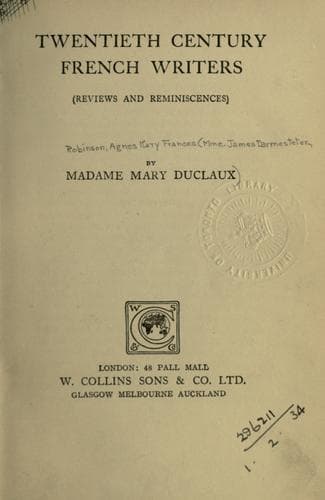
Twentieth Century French Writers: Reviews and ReminiscencesRobinson, A. Mary F. (Agnes Mary Frances)
History
Twentieth Century French Writers: Reviews and Reminiscences
Robinson, A. Mary F. (Agnes Mary Frances)
French literature -- 20th century -- History and criticism
Prenne à présent sa part de la dédicace qui voudra!’
‘Tâcher de porter remède au mal universel humain’: To attempt to
ease the universal disease of humanity! All Péguy is there! As time
went on, he ceased to believe in the establishment of the universal
Socialist Republic; and, indeed, although ineradicably attached to the
Republican ideal, he became increasingly anti-radical, anti-democratic,
almost tending towards the military, and aristocratic theory of a
State strongly constituted in definite classes, each respectable,
respected, and informed with the same sense of national honour and
personal self-sacrifice. But Péguy went back on no word of that
early dedication. He simply made over, so to speak, his stock in the
universal Socialist Republic to the credit of the Catholic Church. For
before Claudel, before Francis Jammes, after Brunetière (or we should
rather say along with him) Péguy suffered a conversion to the faith of
his fathers.
Yet such was his respect for the individual conscience, that he
continued, in the eyes of the Church, to live in sin. His wife, the
daughter of a Socialist, was a Free-thinker; she had never been
baptized; she had married Péguy before the Mayor of her Commune
and not before the priest of her parish; she had not followed him
in his conversion and still maintained her rights. Péguy, that
arch-persuader, could not shake her. And, since the indissolubility of
the marriage-tie was the very cornerstone of Péguy’s social doctrine,
he continued to live with this free-souled woman, who shared his life
but not his faith, in an unblessed union, that the Church condemned;
his children were not baptized. Rome bade him bring them into her
fold. Péguy, in his pride of _pater-familias_, upheld his claim to
consider the convictions of their mother. Deprived of the sacraments,
he ceased to go to Church, while still continuing to believe and
pray.... Anti-clerical and ardently Catholic; tenderly preoccupied
with his children’s welfare and yet accepting for them that which
his new-found creed must have made him conceive as the most dreadful
risk of all--such was the stubborn and irascible convert whom the
Church honours in his death, but whom in his lifetime she covered with
reprimands and ardent reproaches.
Such was Péguy in his life--an enigmatic being; nor was he less
difficult to appreciate in his art, which attempts to enlarge our
sensibility and quicken our moral vision much in the same way as
instantaneous photography has increased and instructed our sense of
sight. I am the first to concede that this art of his (which proceeds,
perhaps, rather from Dostoievski than from any great French tradition)
appears, in its disconcerting diversity, as one of the most interesting
phenomena of a new age. It is full of audacity, interest, genius,
adventure. But is it an art? Let us open any page of Péguy and take at
random a charming page, where the book opens, p. 63 of the _Porche de
la Deuxième Vertu_:--
Public-domain text, read in full here on John Shaqi.
Reviews
Reviews
No reviews yet
Be the first to share your thoughts on this work.
Elsewhere in the archive
Join the Discussion
Join the discussion
Sign in to leave a comment or review.
Sign InorCreate an account