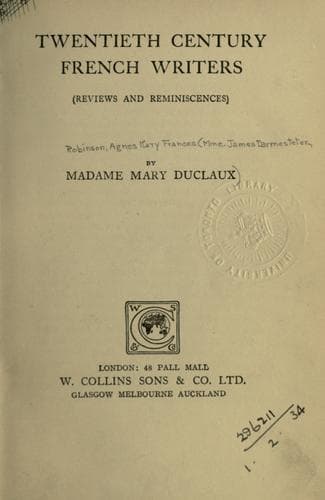
Twentieth Century French Writers: Reviews and ReminiscencesRobinson, A. Mary F. (Agnes Mary Frances)
History
Twentieth Century French Writers: Reviews and Reminiscences
Robinson, A. Mary F. (Agnes Mary Frances)
French literature -- 20th century -- History and criticism
There is, in Péguy at his best, something not so much antique as
unchanged since ancient times, like the pronunciation of certain
peasants; and this something makes us understand how there once was in
France a people of artists, the unknown, unnamed, immortal builders of
the great Gothic cathedrals; we almost believe there might still be
such in reading his verse.
There is also in Péguy at his best a peculiar humanity which makes me
often remember those lines of Mrs Browning concerning her favourite
Greek poet:--
‘Our Euripides the Human
With his droppings of warm tears,’
and an imagination so naturally and naïvely religious that it would
enchant me but for its familiarity. No Baptist minister over his tea
and muffins, is on more intimate terms with the Eternal.
The interminable poem of _Eve_ (as long--but not as beautiful!
as the _Iliad_ and the _Odyssey_ united) fulminates against the
Intellectuals of France in an outburst of rhetoric which too often
degenerates into mere violence. Péguy is more really poetic in his
prose. The description of rural life on the banks of the Loire, in
_Victor-Marie_, _Comte Hugo_; the death of Bernard Lazare in _Notre
Jeunesse_; above all, the long but the inspired elevations and
prayers of Jeannette--especially the conversation with her little
fourteen-year-old friend Hanorette (which we keep in our remembrance
along with the dialogue of Antigone and Ismene, and with the scene in
the Gospel of Martha and Mary, as a perfect characterisation of the
two great types of Charity and Piety)--are to our thinking far more
interpretative of Péguy’s true genius than the mighty jog-trot of his
later muse. Still there is a power and an eloquence in that. So far
as the meaning goes, all his voluminous outpourings have the same.
There is but one thing needful, and that is to be a hero or a saint.
Preferably, perhaps, a hero!
‘Ainsi Dieu ne sait pas, ainsi le divin maître
Ne sait quel retenir et placer hors du lieu,
Et pour lequel tenir, et s’il faut vraiment mettre
L’amour de la patrie après l’amour de Dieu.’
The saints that Péguy sang were patriot saints: Geneviève, who
preserved the city of Paris from the Huns of Attila; Jeanne, who hunted
the English out of France. Of all glories, of all honours, that dearest
to this poet was military glory and national honour--
‘Il n’y a rien à faire à cela, et il n’y a rien à dire. Le soldat
mesure la quantité de terre où on parle une langue, où règnent des
mœurs, un esprit, une âme, un culte, une race. Le soldat mesure la
quantité de terre où une âme peut respirer. Le soldat mesure la
quantité de terre où un peuple ne meurt pas.
Public-domain text, read in full here on John Shaqi.
Reviews
Reviews
No reviews yet
Be the first to share your thoughts on this work.
Elsewhere in the archive
Join the Discussion
Join the discussion
Sign in to leave a comment or review.
Sign InorCreate an account