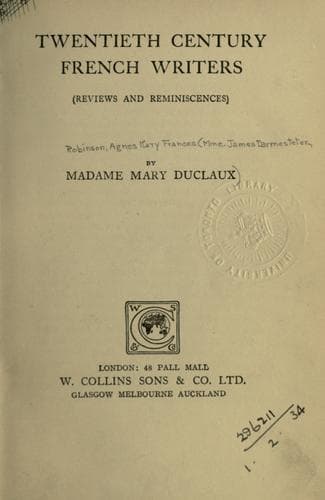
Twentieth Century French Writers: Reviews and ReminiscencesRobinson, A. Mary F. (Agnes Mary Frances)
History
Twentieth Century French Writers: Reviews and Reminiscences
Robinson, A. Mary F. (Agnes Mary Frances)
French literature -- 20th century -- History and criticism
This was Péguy’s firm conviction: no duty so important as the military
duty! When the war broke out, man of forty as he was and father of
a struggling family--man, too, much engrossed and overworked by his
triple occupation as poet, prose-writer, and publisher--he changed from
the Territorials into a regiment sent on active service to the front.
‘No man hath greater love than this....’
Thanks to the recital of one of his soldiers, Victor Bondon, we can
witness the fall--or rather I would say the assumption--of the poet and
brother of Joan of Arc. For he too fell in driving the invader out of
France! There is an extraordinary breath of heroism in this page of an
unknown private soldier relating the end of a great man. I cannot do
better than translate it here, with some abridgments and suppressions:--
‘On the 5th September in the morning, the 55th division of the army
of Paris was ranged on the left of the forces which had received
the general order, “Die where you stand, rather than retreat.”
In front of us, on the wooded hills that reach from Dammartin to
Meaux, von Klück and his Boches, who had followed us step by step
from Roye during our terrible retreat, lay in wait for us, hidden
in their trenches, like beasts of prey.
‘The heat was tropical; the battalion halted a moment at the pretty
village of Nantouillet. I see again, with the mind’s eye, our dear
Lieutenant Péguy, seated on a stone, white with dust (as indeed
we all were), covered with sweat, his beard rough and shaggy, his
eyes shining behind his pince-nez. Such he was, as we had seen
him in Lorraine during the retreat, impervious to fatigue, brave
under a storm of shells, going from one to another of his men
with a cheering word for each throughout the whole length of our
company (the 19th), sharing our rations (and we eat as a rule one
day in three), never complaining despite his forty years, as young
as the youngest, knowing just the right way to take the Parisians
that we were, heartening the discouraged with a word, satirical
enough sometimes, but more often a friendly quizzical quip, always
brave, always an example; ah, yes! I see again our dear lieutenant,
bidding us fight in hope, raising our flagging spirits in an hour
when many were near despairing, with the assurance of his own
absolute confidence in our final victory.’
Public-domain text, read in full here on John Shaqi.
Reviews
Reviews
No reviews yet
Be the first to share your thoughts on this work.
Elsewhere in the archive
Join the Discussion
Join the discussion
Sign in to leave a comment or review.
Sign InorCreate an account