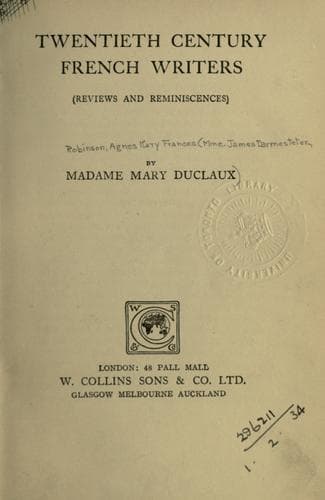
Twentieth Century French Writers: Reviews and ReminiscencesRobinson, A. Mary F. (Agnes Mary Frances)
History
Twentieth Century French Writers: Reviews and Reminiscences
Robinson, A. Mary F. (Agnes Mary Frances)
French literature -- 20th century -- History and criticism
I never really ventured to tell Émile Nolly what I thought of those
books, so I said nothing about them--a language which he perfectly
understood and accepted with that grim, not untender smile of his. No
one better than he knew the charm of art and romance. And I imagine
he felt a certain fierce pleasure in flinging all that to the winds,
in order, as he thought, to be more useful, reach a wider public,
and influence it with the directness of a popular sermon. What use,
after all, was there in his two stories of Indo-China, or in _Gens de
Guerre au Maroc_? They were inclined, if anything, to inspire a morbid
pessimism. On the whole, it is the first of his novels which I shall
most often re-read--_Hiên le Maboul_, a book so poignant, clear and
mild in its sadness, that it haunts our imagination for years after
the last page is closed. No one, perhaps, has so well expressed the
peculiar beauty of Tonquin.... When, after Egypt, Aden, Ceylon, the
Frenchman reaches the Delta, his first instinctive expectation is of
something stranger still; are we not here at the end of the world?
‘χθονὸς μεν ἐς τηλoυρὸν ἠκoμεν πέδoν,
Σκύθην ἔς oῖμoν, ἂβατον εἰς ἒρημίαν.’
But what is this gray land where the silvery winter sunshine floats
veiled by an imperceptible haze? Is it Brittany? Or a misty March day
in the _Landes_, when the sun shines? And see, that ruined tower set
on the round breast of a hill, with the far-off scaurs and peaks in
the background--is it Auvergne? Nor, in the character of the conquered
people, does there appear at first the difference that separates the
Frenchman from the solemn Arab or the barbarous Kanak; the Annamite,
with his wide intelligence, his keen and quizzical wit, his love
of hearth and home, his respect for tradition and his religious
indifference, appears at once a man and a brother. A certain aloofness
adds to his charm.... Such was the new and yet half-familiar world with
which Émile Nolly made us acquainted. _Hiên le Maboul_ is a yellow
brother of Loti’s _Mon frère Yves_.
And yet, on reopening the charming book (so appealing in its tender
hopelessness, its elegant sobriety), I find, even here, the Pragmatist
apostle who wrote Nolly’s later works! For what is the nexus of the
novel? It is surely the despair of the young French lieutenant when
he finds himself impotent to save the native _tirailleur_ who, in
an hour of moral anguish, comes to ask his infallible superior ‘les
paroles qui guérissent.’ Alas, with all his science, the ‘Ancestor with
the two stripes’ does not know the words that save; his philosophy
affords him nothing but idle formulas void of faith and healing. And
thenceforth his whole system of civilisation seems to him wanting and
inefficacious. For Hiên goes out in silence and hangs himself to a
banyan-tree.
Public-domain text, read in full here on John Shaqi.
Reviews
Reviews
No reviews yet
Be the first to share your thoughts on this work.
Elsewhere in the archive
Join the Discussion
Join the discussion
Sign in to leave a comment or review.
Sign InorCreate an account