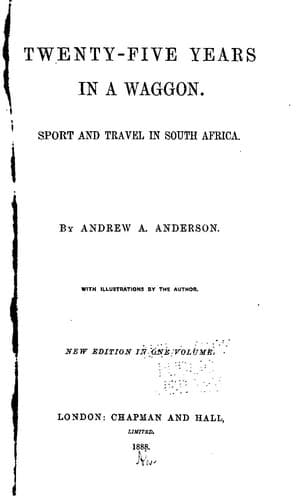
Twenty-Five Years in a Waggon in South Africa: Sport and Travel in South AfricaAnderson, Andrew A.
History
Twenty-Five Years in a Waggon in South Africa: Sport and Travel in South Africa
Anderson, Andrew A.
Africa, Southern -- Description and travel; Anderson, Andrew A. -- Travel -- Africa, Southern
At the commencement of December, when we expected the Boers would make
an attack on the town, all the males in the four wards of the city
volunteered to protect the women and children in each ward, and as my
waggon was outspanned in Number 4, I joined with the rest; but when the
news came into Pretoria that the Boers, to the number of 1000, had been
in ambush at Bronkhurst spruit for two days, waiting for the advance of
a portion of the 94th Regiment from Lydenburg, which had been murdered
by the Boers, a council was held, and on the 20th of December martial
law was proclaimed, and all those who had formed themselves into
volunteers to protect women and children were marched up to the barracks
as regular volunteers. My waggon was drawn up to camp, and placed under
the charge of the authorities during my soldiering.
The history of this rebellion has been so ably and graphically described
by others, it will be useless for me to go more into the subject. I can
merely state the first news of the British surrender that reached camp,
of the war being concluded, and the retrocession of the Transvaal to the
Boers, arrived on the 28th of March, 1881.
The principal portion of the Transvaal, north of Pretoria in the
Zoutpansberg and Waterberg districts, is called the bush veldt, where
most of the farmers living on the high veldt, between Potchefstroom and
Pretoria, trek at the close of the autumn with all their family and
stock, and remain the winter, where the cattle and sheep find warm
shelter in the thorn forests; and return to their farms when the spring
grass is sufficiently high for the stock to feed. The Boers make this
trek a kind of picnic, and it is the only kind of life they enjoy.
This high land is also called Witwater rand; the elevation above
sea-level is 5800 feet. Extensive seams of coal have been discovered
about forty miles to the east-south-east of Pretoria. Roads in every
direction traverse the country. The distances from Pretoria to the
following places are: to the west, Rustenberg, 40 miles; north to
Marabastadt, 160 miles; east to Middleberg, 100 miles; and to Lydenburg,
165 miles; south to Heidelburg, 55 miles; Standerton, 120 miles; and
Newcastle, 190 miles; south-west to Potchefstroom, 110 miles; and to
Kimberley diamond-fields, 334 miles. Middleberg is a small village on
the road from Pretoria to Lydenburg, and the gold-field is in this
district; a cobalt-mine has been discovered. Lydenburg is situated in
the open country, on a branch of the Spekboom river. The country round
is very hilly, some of them attain a height of 8000 feet above
sea-level. The average height of the gold-diggings is 4200 feet.
Public-domain text, read in full here on John Shaqi.
Reviews
Reviews
No reviews yet
Be the first to share your thoughts on this work.
Elsewhere in the archive
Join the Discussion
Join the discussion
Sign in to leave a comment or review.
Sign InorCreate an account