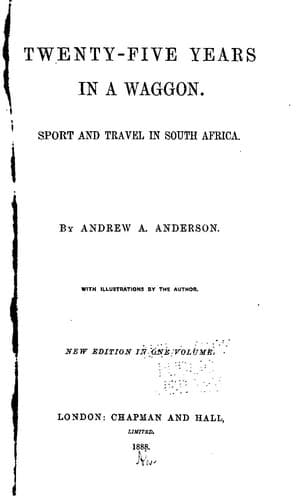
Twenty-Five Years in a Waggon in South Africa: Sport and Travel in South AfricaAnderson, Andrew A.
History
Twenty-Five Years in a Waggon in South Africa: Sport and Travel in South Africa
Anderson, Andrew A.
Africa, Southern -- Description and travel; Anderson, Andrew A. -- Travel -- Africa, Southern
It was from this station, in 1837, that the Boers who escaped from the
fight with Moselikatze, joined the Barolongs to drive that chief from
Mosega, and collected a force of 1000 men. Montsioa, the present chief,
held command of part of the expedition, and through the Basuto
assistance, the Boers managed to drive Moselikatze more to the north.
We now see the return they get for this help: their country at Thaba
Nchu taken from them, and Montsioa would have lost his, and himself and
people been murdered, if the British Government had not stepped in at
the eleventh hour and saved them. Basutoland, which is separated from
Thaba Nchu, is now under British protection, and is one of the finest
wheat-growing countries in South Africa, and the natives, if they had
been let alone, would have remained at peace, as they were growing rich
in supplying the diamond-fields with corn. But as their country joins
for such a distance to the Free State, which is occupied by a Boer
population, it is impossible for them to remain in peace for long, for
no tribe, however peacefully inclined the people may be, can with Boers
on their border remain so long, as the latter have many ways of causing
a disturbance, which we have so frequently witnessed, as in the case of
Montsioa and Monkuruan, and the only way to prevent any further trouble
in that country was for the British Government to take it under their
protection. Thaba Bosigo is their principal town and one of their
mission stations.
The Orange Free State occupies the whole of that part of Africa lying
between the Cape Colony, Basutoland, Natal, and the Transvaal.
Bloomfontein is the capital and seat of Government. Mr. Brand is the
President, now Sir John Brand, with a Volksraad to carry on the
Government, and contains within its area about 55,000 square miles.
The principal rivers are the Vaal, Orange, and Caledon, that form the
boundary. The tributaries of the Vaal are the Likwa spruit, the
north-east boundary, Klip, Welge, Rhenoster, Valsch, Vet, Modder, and
Keit.
The principal towns are Harrismith, situated on the north-east portion
of the State, about twenty-five miles north of the Drakensberg range,
the boundary of Natal, and on the main transport roads from Natal to the
diamond-fields, Bloomfontein, Potchefstroom, and Pretoria in the
Transvaal; also Winburg, Cronstad, Boschof, Keckstad, Fauresmith, and
many others of lesser note.
The country is almost one unbroken open grass plain, very scarce of
wood; in some parts there are long stretches of thorn, principally
mimosa bush, but the demand for wood at the diamond-fields is so great
that in a few years there will be scarcely a stick worth cutting, as the
price for a waggon-load of wood varies from ten to thirty pounds. A
large proportion of the population in the various towns are English and
other nationalities.
Public-domain text, read in full here on John Shaqi.
Reviews
Reviews
No reviews yet
Be the first to share your thoughts on this work.
Elsewhere in the archive
Join the Discussion
Join the discussion
Sign in to leave a comment or review.
Sign InorCreate an account