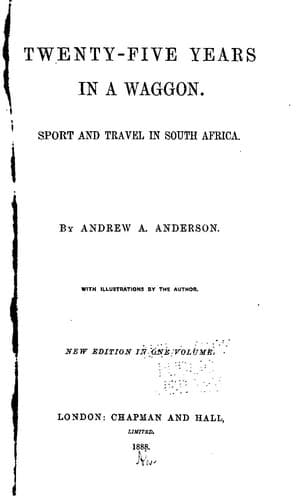
Twenty-Five Years in a Waggon in South Africa: Sport and Travel in South AfricaAnderson, Andrew A.
History
Twenty-Five Years in a Waggon in South Africa: Sport and Travel in South Africa
Anderson, Andrew A.
Africa, Southern -- Description and travel; Anderson, Andrew A. -- Travel -- Africa, Southern
The climate in winter is cold, but dry. The elevation averages 4500
feet above sea-level, which is the cause. Fortunately the winters are
dry. The rainy season is from November to April. In the summer months
very severe thunderstorms pass over the country. Generally there is a
great want of water previous to the rainy season, and many cattle die
from cold and starvation. Game, twenty years ago, was plentiful, and
also lions; but only a few blesbok, wildebeest, and springbok are to be
met with. Some of the farmers have now begun to preserve them on their
farms, otherwise they would have long since disappeared from the
country. Lions have all been destroyed, but a few wolves are still
left. In parts of the country there are some very pretty localities,
where the woods are preserved, and occasionally may be seen several
hundred baboons visiting those parts for the gum, of which they are very
fond. Many of them are of great size; they may be heard a long
distance, as they pass with their half-human grunts, and it would be
dangerous for any single individual unarmed to come across their path.
It is impossible for any great improvement to be made in the present
state of affairs in the State. The country is too poor, and with very
little chance of its ever becoming richer, with such a lack of energy
for advancing in civilisation as is in the Boer character.
The British colony of Natal is situated on the coast, and joins on to
the Cape Colony at its extreme eastern boundary, called Kaffirland
proper, and Griqualand East as also Basutoland. To the north it joins
up to the Orange Free State, and the Transvaal, the Drakensberg mountain
dividing it from them. On the eastern side, Zululand is separated from
it by the Tugela and the Buffalo rivers. It has a coast-line of 150
miles. The extreme northern point is in 27 degrees 25 minutes South
latitude, down to 31 degrees 10 minutes. The extreme western point is
in 29 degrees 4 minutes, to 31 degrees 30 minutes, being the eastern
point at the mouth of the Tugela, where Zululand joins it.
It is governed by a Lieutenant-Governor, and Executive and Legislative
Councils. The principal town is Maritzburg, situated about fifty miles
inland from the port of Durban. The latter has become an important
town, where all the shipping trade is carried on for the colony and the
interior. On the main transport road to the Free State and Transvaal
are Howick, close to the Umgeni waterfall, Weston, Estcourt, Colenzo,
Ladysmith, and Newcastle. East of Maritzburg is Richmond; north of
Durban is Pinetown, and many others in various parts of the country.
Public-domain text, read in full here on John Shaqi.
Reviews
Reviews
No reviews yet
Be the first to share your thoughts on this work.
Elsewhere in the archive
Join the Discussion
Join the discussion
Sign in to leave a comment or review.
Sign InorCreate an account