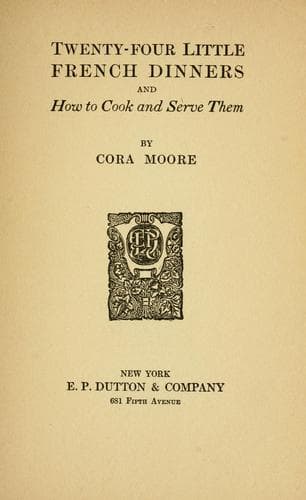
Twenty-four Little French Dinners and How to Cook and Serve ThemMoore, Cora
General
Twenty-four Little French Dinners and How to Cook and Serve Them
Moore, Cora
Cooking, French
The very economy of the French is an art, and there is art in their
economy. It is true that their dishes, as we have known them in this
country, are expensive, even extravagant, but that is because they have
been for the most part the creations of high-priced chefs. They who have
made eating an avocation know that it is not necessary to dine
expensively in order to dine well.
C. M.
New York, May, 1919.
CONTENTS
PAGE
Preface v
The Bugbear of American Cookery--Monotony 1
Flavor--Handmaid of Variety 9
True Trails toward Economy 15
The Appeal to the Eye 21
Sauces, Simple and Otherwise 25
Twenty-four Little French Dinners 33
(With Directions for Preparing)
Let Us Eat Fish! 109
TWENTY-FOUR LITTLE
FRENCH DINNERS
AND
How to Cook and Serve Them
THE BUGBEAR OF AMERICAN COOKERY--MONOTONY
It is as strange as it is true that with the supplies that have lately
proved sufficient to feed a world to draw upon the chief trouble with
American cookery is its monotony. The American cook has a wider variety
of foods at his command than any other in the world, yet in the average
home how rarely is it that the palate is surprised with a flavor that
didn't have its turn on the corresponding day last week or tickled with
a sauce that is in itself an inspiration and a delight, not a mere
"gravy," liable to harden into lumps of grease when it cools.
Most of this is simply the result of blindly following tradition.
Daughter has accepted mother's precepts, regarding them even as the law
of the Medes and the Persians, "which altereth not," and if it were not
that increased prices and, lately, at least, "food regulations," have
veritably compelled her toward a more wholesome simplicity, the United
States would probably be what it was called half a generation ago, "a
nation of dyspeptics." And we were a nation of dyspeptics because the
great American mother of the latter end of the Nineteenth Century, in
spite of all her unequaled qualities in every other direction, and in
spite of all the encomiums she received in resounding prose or ecstatic
verse for her prowess in the kitchen, was from the points of view of
health, economy and wisdom the worst cook in the world.
Public-domain text, read in full here on John Shaqi.
Reviews
Reviews
No reviews yet
Be the first to share your thoughts on this work.
Join the Discussion
Join the discussion
Sign in to leave a comment or review.
Sign InorCreate an account