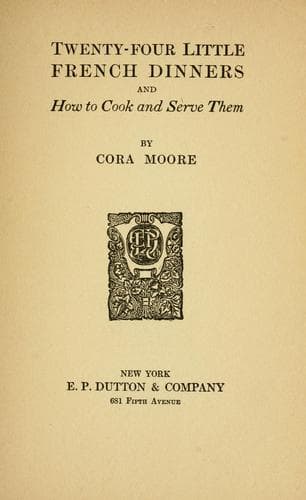
Twenty-four Little French Dinners and How to Cook and Serve Them — John Shaqi
Twenty-four Little French Dinners and How to Cook and Serve ThemMoore, Cora
General
Twenty-four Little French Dinners and How to Cook and Serve Them
Moore, Cora
Cooking, French
With prices as they are the American housewife cannot afford to use
butter and eggs and flour with the prodigality that was a habit with her
mother, but so limited is the average woman's knowledge of cookery that
these restrictions merely mean more monotony than ever. It is partly to
demonstrate that this state of things is unnecessary and that true food
economy is not at all synonymous with "going without" that this book has
been compiled.
It is upon variety that the French cook confidently relies to make each
dish of each meal not just something to eat because her family must have
food, not merely a sop to the Cerberus-gnawings of hunger, but a delight
to the eye, to the palate, to the stomach--truly a consummation devoutly
to be wished for the American home table, and just as possible to attain
as it is possible to procure from the grocer or the nearest pharmacist
the ingredients by which these wonders are wrought.
But the average American woman doesn't look beyond her own kitchen and
her own traditional row of spice boxes for her flavorings. She has her
"kitchen set," which ordinarily comprises a row of little receptacles
labeled "pepper," "salt," "cloves," "allspice," "ginger," "cinnamon,"
"nutmeg," and possibly one or two other spices or condiments--rarely
more. With these and a bottle each of lemon extract and vanilla, she is
satisfied that she is fully equipped as far as flavoring possibilities
are concerned.
If she has laid in a box of sage and one of mixed dressing with,
perhaps, some paprika and thyme, she views her foresightedness with much
complacency. She is supplied with savories.
Then she goes right on sighing, "Oh, for a new meat, instead of the same
old round of mutton, pork, beef and fish; fish, beef, mutton and pork,"
disclaiming utterly any responsibility for the monotony that is
undermining the family health and temper and, quite possibly, its
morals.
That is where the American housewife makes her primary and most
important mistake. The French, on the other hand, know that there are,
literally, hundreds of ways to vary every dish, however ordinary it may
be in its primary state. That is their secret of success: unfailing
variety coupled with economy.
However, this is not to claim that the American palate would take kindly
to all the French cooks' little delicacies, or that it could be
cultivated to that degree that makes a Frenchman regard a perfectly
balanced meal even as an inspired poem.
Probably Americans, as a class, could never be induced to eat some of
the little birds--the _mauviettes_, the _alouettes_, the sparrows baked
in a pie, that so delight the Frenchman. Also, it is a question whether
snails, even if it were possible to obtain the superior Burgundian, fat
and juicy and cooked even as our own Oscar used to prepare them for
certain Waldorf guests, would ever appeal to the American taste, as even
the common hedgerow sort of snail does to the average Frenchman.
Public-domain text, read in full here on John Shaqi.
Reviews
Reviews
No reviews yet
Be the first to share your thoughts on this work.
Join the Discussion
Join the discussion
Sign in to leave a comment or review.
Sign InorCreate an account