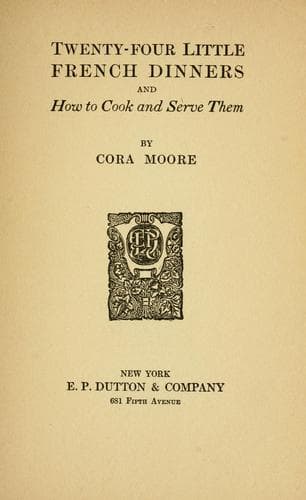
Twenty-four Little French Dinners and How to Cook and Serve ThemMoore, Cora
General
Twenty-four Little French Dinners and How to Cook and Serve Them
Moore, Cora
Cooking, French
It is not that the French dinners of Monte Carlo are necessarily so
superior to American shore dinners, or that the little dinners of Paris
are so infinitely to be preferred to those, say, of certain places in
New Orleans, or that the coppery-tasting oysters of Havre are to be
compared with those of our own Baltimore. There is no more to be said,
probably, for the woodcock patés of old Montreuil, or the _rillettes_ of
Tours, or the little pots of custard one gets at the foreign Montpelier,
or the _vol-au-vent_, which is the pride and boast of the cities of
Provence, than there is for grandmother's cookies such as have put
Camden, Maine, on the map, or Lady Baltimore cakes, or the chicken pies
one goes to northern New Hampshire to find in their glory, or the
turkeys that, as much as the Green Mountains, make Vermont's fame.
Still, there is no question but that the American palate would benefit
much by being cultivated, not only in the interests of economy, but also
with a view to the increase of gastronomic pleasure, for a taste attuned
to many variations is as an ear sensitive to the nuances of sweet sounds
or an eye trained to perceive delicate tones and tints. It is really a
matter for regret that we, as a people, have not been as willing to
learn from the French the art of cooking and eating as we have been to
acquire from them knowledge of the art of dress. Until we widen our
horizon sufficiently to do this, we have not even begun to develop all
our food resources or to understand the first principles of true food
economy--which is not at all synonymous with "going without."
FLAVOR, HANDMAID OF VARIETY
It is because he has a multitude of seasonings at his command and knows
how to use them that the French cook is enabled not only to send to the
table an infinite variety of dishes, but, at the same time, to practice
economies that were otherwise impossible. The American buys an expensive
cut of meat and, as is right in such a case, treats it as plainly and
simply as possible. The Frenchman buys meat of a much lower quality, but
so embellishes it that when it comes to the table it is superior, or, at
least, equal to that which costs much more.
It may be objected that this is no real economy, because by the time the
French cook has sauced and spiced his cheap cut in order to make it
palatable, the cost is as great, if not greater than it would have been
had he paid more for his meat in the first place. This would be true
enough according to the average American's method of procedure. But it
is to be remembered that the French cook has already in his kitchen the
cooking vinegars, the spices, the dried herbs, the extracts, that in
very small amounts--a dash or a few leaves--are used at a time; also,
that in a great number of cases, gravies and sauces are made from the
by-products of the main dishes--those by-products that in the American
kitchen usually go down the sink-drain or into the garbage pail.
Public-domain text, read in full here on John Shaqi.
Reviews
Reviews
No reviews yet
Be the first to share your thoughts on this work.
Join the Discussion
Join the discussion
Sign in to leave a comment or review.
Sign InorCreate an account