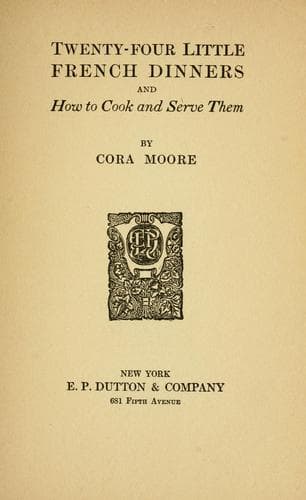
Twenty-four Little French Dinners and How to Cook and Serve ThemMoore, Cora
General
Twenty-four Little French Dinners and How to Cook and Serve Them
Moore, Cora
Cooking, French
Stale bread and breadcrumbs are the bases of a score of the most
delicious puddings on the French cook's card; cooked cereal is one of
the best thickenings for soups and gravies, as well as being far more
wholesome than flour for this purpose; meat scraps, trimmings and bones
should go into the stock pot. When a soup made of these is served as the
introductory course at dinner it will be found that the family will be
fully satisfied with much less meat, and it is in the lessening
dependence of Americans on meat that will make for the greatest item in
economy.
A French cook of parts would tear his hair if he could see how fats and
drippings from meats are thrown away in many an American kitchen. They
are poured into the sink till the drain pipes clog and, to complete the
little serial of extravagance, the plumber has to be called. The French
cook knows that this is the finest grease for frying in the world and
that its use would save many a pound of butter. He strains it all
carefully and keeps the different sorts in labelled jars or crocks. He
knows by experience what particular fats give the best flavors to
certain things, and he knows that vegetables, fish, eggs, pancakes and
what not are far better fried in these natural fats. Who that ever ate
an egg fried in bacon drippings will ever want one cooked in butter,
even at a dollar a pound!
One will not find the delicatessen flourishing in France--one will not
find it at all--and the fancy grocery, above mentioned, is another
pitfall for the American housewife. She likes the sight of food done up
in fancy containers, in glass, perhaps, and buys them, not realizing
that she is paying a large price for perfectly unnecessary and totally
unnourishing "pretties." If she is fearful of the handling some loose
food stuffs may be subjected to in the stores, why does she not practice
the most practical economy, go to the fountain-head of supplies in the
city, the large market, and buy in quantity, so far as she can? A few
ounces of bacon, already sliced, and sealed in a glass dish are, indeed,
appetising even in their raw state, while a side of bacon is not, unless
looked upon through the eyes of imagination, yet the latter method of
purchasing this commodity is two or three hundred per cent cheaper, and
when it arrives at the breakfast table it will be found every bit as
appealing to a happy morning appetite.
Any consideration of economy in the cuisine must include the meat
problem. Meat is the most expensive item on the menu and the true
solution of the question is not only to conserve all the uses of it but
to eat much less. That would make not only for economy, but for better
health as well.
Public-domain text, read in full here on John Shaqi.
Reviews
Reviews
No reviews yet
Be the first to share your thoughts on this work.
Join the Discussion
Join the discussion
Sign in to leave a comment or review.
Sign InorCreate an account