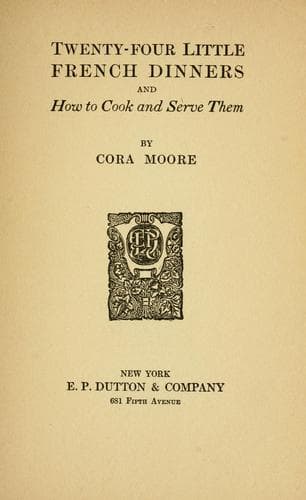
Twenty-four Little French Dinners and How to Cook and Serve ThemMoore, Cora
General
Twenty-four Little French Dinners and How to Cook and Serve Them
Moore, Cora
Cooking, French
It has been estimated that 186 pounds of dressed meat is--or was prior
to the war--the yearly average of consumption for every American; the
Englishman being a good second with his 120 pounds, while the Frenchman
remained perfectly contented and healthy with 79 pounds, the Italian
with 72 pounds, and the Swiss, anything but a nation of invalids,
managed very well on 60 pounds per person.
This is no plea for vegetarianism, though it may be said in passing for
the benefit of those who think that good red blood and hardy muscle are
to be obtained only by absorbing the red blood and muscle of the beasts
of the field, that there is as much, if not more, of this building
power in the beans, the peas, the lentils that we regard too often as
mere secondary foods.
Most of all the American should take advantage of the great stores of
fish which are equally as nourishing as meat and may easily be made as
appetising with simple sauces that French cookery will teach us. Fish
are cheap; at least, many neglected kinds are; they are easy to cook and
they are one of the best foods in the world.
THE APPEAL TO THE EYE
No one, least of all the French cook, calculates to feast the eye at the
expense of the sense of taste, yet it is his experience after long years
that good digestion is much more likely to wait upon the appetite that
has been stirred to a preliminary enthusiasm by the attractive
appearance of a dish. So they serve little fritters of vegetables, dabs
of jelly, slices of hard boiled eggs, pickles, parsley, cress and
nasturtiums with meats, put sprigs of fresh green in their gravies,
decorate desserts with nut-meats, flowers and fruits, and in so doing
add a bit to the gayety of the table, satisfied that the trifling extra
expense, time and energy incurred is more than compensated for in the
pleasure the results afford. A fair trial of this pleasant idiosyncrasy
of the French is convincing that the appearance of a dish has more
bearing on the relish of a meal than we over here have fully realized.
They are particular, however, to be consistent in the use of
garnishings. Flowers and fruits are reserved for sweet dishes, except in
the case of nasturtiums, which they regard as much a vegetable as a
flower and use freely with meats.
A stew or a creamed dish is merely a more or less indifferent something
to eat when it is dished up any old way and set upon the table. But if
it is heaped daintily on a pretty platter, surrounded by a ring of brown
mashed potato, its sides decorated by dainty shapes of toasted bread,
perhaps buttered and sprinkled with minced parsley, it has become
something to awaken the slumbering or indifferent appetite and at
practically no extra expense of time or money.
Public-domain text, read in full here on John Shaqi.
Reviews
Reviews
No reviews yet
Be the first to share your thoughts on this work.
Join the Discussion
Join the discussion
Sign in to leave a comment or review.
Sign InorCreate an account