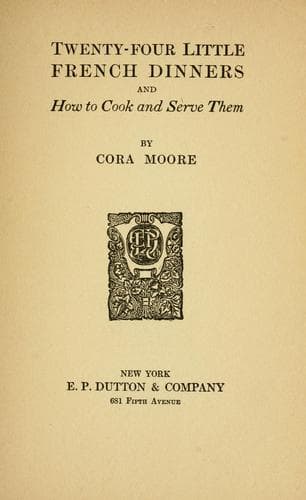
Twenty-four Little French Dinners and How to Cook and Serve ThemMoore, Cora
General
Twenty-four Little French Dinners and How to Cook and Serve Them
Moore, Cora
Cooking, French
If the yolks of two hard boiled eggs are minced and mixed with part of
the raw white of one, the paste then formed into balls like marbles and
dropped into boiling water, one has little yellow spheres to lend an
enlivening color note to clear soups. Two or three of these dropped into
each plate just before serving makes a pleasing change from the usual
croutons.
Sprigs of fresh chickory make the daintiest of garnishes for cold meats,
and a few of the tender green stalks will add to the appearance of
practically any salad. As for water-cress and pepper-grass and, of
course, parsley, minced and otherwise, no French chef would think of
preparing a meal without a plentiful supply of them on hand.
It isn't essential that every dish should be turned into an elaborate
work of art, as if it were to be entered at the annual exhibition of the
Société des Chefs de Cuisine, but neither is there any reason, even with
modest means at command, for giving cause for that old slogan of the
great American dinner table: "It tastes better than it looks."
SAUCES, SIMPLE AND OTHERWISE
Brillat-Savarin, who would be remembered as a wit had he not been even
more brilliant as a chef, paid his respects to the English by saying
they were a nation of a hundred religions and only one sauce. Being a
true Frenchman he believed a reversal of the numbers better for the
soul. It is certainly better for the appetite.
To be sure the proper mental sauce for a good dinner is wit, and the
best physical one, hunger, but as we all of us have more or less of an
Epicurean strain in us and do not eat solely to satisfy bodily needs, it
is well that the American cook who essays to bring variety to her board
should have some knowledge of those Gallic creations, the sauces, by
which she is enabled to transform plain dishes into seemingly
pretentious ones, even though she never attain that sauce that Balzac
knew, "in which a mother might unsuspectingly eat her own child."
In the first place every French chef keeps three kinds of what he calls
_roux_ on hand, ready for making meat and fish sauces. These are made by
cooking together eight ounces of butter and nine ounces of flour. That
intended for use with brown meats is stirred together till it becomes a
medium brown in shade; white _roux_ is cooked only sufficiently to
banish the raw taste and not allowed to color, while pale _roux_ is kept
over the fire just long enough to attain a deep cream color. These are
mixed with milk, soup stock, water or gravy as the case may be when a
sauce for fish, meat or vegetables is needed.
Public-domain text, read in full here on John Shaqi.
Reviews
Reviews
No reviews yet
Be the first to share your thoughts on this work.
Join the Discussion
Join the discussion
Sign in to leave a comment or review.
Sign InorCreate an account