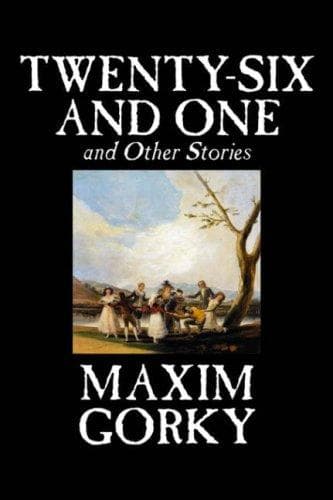
Twenty-six and One, and Other StoriesGorky, Maksim
General
Twenty-six and One, and Other Stories
Gorky, Maksim
Russia -- Social life and customs -- Fiction; Short stories, Russian -- Translations into English
Gorky dreamed of the free air. He abandoned the bakery. Always
reading, studying feverishly, drinking with vagrants, expending his
strength in every possible manner, he is one day at work in a saw-mill,
another, 'longshoreman on the quays. . . . In 1888, seized with
despair, he attempted to kill himself. "I was," said he, "as ill as I
could be, and I continued to live to sell apples. . . ." He afterward
became a gate-keeper and later retailed _kvass_ in the streets. A
happy chance brought him to the notice of a lawyer, who interested
himself in him, directed his reading and organized his instruction.
But his restless disposition drew him back to his wandering life; he
traveled over Russia in every direction and tried his hand at every
trade, including, henceforth, that of man of letters.
He began by writing a short story, "Makar Tchoudra," which was
published by a provincial newspaper. It is a rather interesting work,
but its interest lies more, frankly speaking, in what it promises than
in what it actually gives. The subject is rather too suggestive of
certain pieces of fiction dear to the romantic school.
Gorky's appearance in the world of literature dates from 1893. He had
at this time, the acquaintance of the writer Korolenko, and, thanks to
him, soon published "Tchelkache," which met with a resounding success.
Gorky henceforth rejects all traditional methods, and free and
untrammeled devotes himself to frankly and directly interpreting life
as he sees it. As he has, so far, lived only in the society of tramps,
himself a tramp, and one of the most refractory, it has been reserved
for him to write the poem of vagrancy.
His preference is for the short story. In seven years, he has written
thirty, contained in three volumes, which in their expressive brevity
sometimes recall Maupassant.
The plot is of the simplest. Sometimes, there are only two personages:
an old beggar and his grandson, two workmen, a tramp and a Jew, a
baker's boy and his assistant, two companions in misery.
The interest of these stories does not lie in the unraveling of an
intricate plot. They are rather fragments of life, bits of biography
covering some particular period, without reaching the limits of a real
drama. And these are no more artificially combined than are the events
of real life.
Public-domain text, read in full here on John Shaqi.
Reviews
Reviews
No reviews yet
Be the first to share your thoughts on this work.
Join the Discussion
Join the discussion
Sign in to leave a comment or review.
Sign InorCreate an account