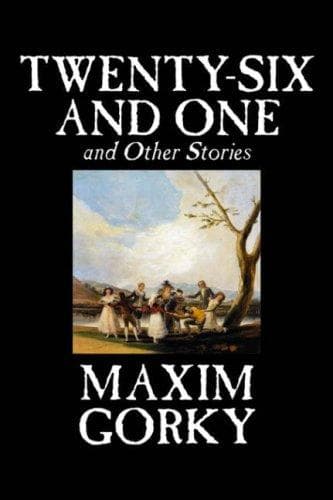
Twenty-six and One, and Other StoriesGorky, Maksim
General
Twenty-six and One, and Other Stories
Gorky, Maksim
Russia -- Social life and customs -- Fiction; Short stories, Russian -- Translations into English
Everything that he relates, Gorky has seen. Every landscape that he
describes has been seen by him in the course of his adventurous
existence. Each detail of this scenery is fraught for him with some
remembrance of distress or suffering. This vagrant life has been his
own. These tramps have been his companions, he has loved or hated
them. Therefore his work is alive with what he has almost
unconsciously put in of himself. At the same time, he knows how to
separate himself from his work; the characters introduced live their
own lives, independent of his, having their own characters and their
own individual way of reacting against the common misery. No writer
has to a greater degree the gift of objectivity, while at the same time
freely introducing himself into his work.
Therefore, his tramps are strikingly truthful. He does not idealise
them; the sympathy that their strength, courage, and independence
inspire in him does not blind him. He conceals neither their faults,
vices, drunkenness nor boastfulness. He is without indulgence for
them, and judges them discriminatingly. He paints reality, but
without, for all that, exaggerating ugliness. He does not avoid
painful or coarse scenes; but in the most cynical passages he does not
revolt because it is felt that he only desires to be truthful, and not
to excite the emotions by cheap means. He simply points out that
things are as they are, that there is nothing to be done about it, that
they depend upon immutable laws. Accordingly all those sad, even
horrible spectacles are accepted as life itself. To Gorky, the
spectacle presented by these characters is only natural: he has seen
them shaken by passion as the waves by the wind, and a smile pass over
their souls like the sun piercing the clouds. He is, in the true
acceptation of the term, a realist.
The introduction of tramps in literature is the great innovation of
Gorky. The Russian writers first interested themselves in the
cultivated classes of society; then they went as far as the moujik.
The "literature of the moujik," assumed a social importance. It had a
political influence and was not foreign to the abolition of serfdom.
In the story "Malva," Gorky offers us two characteristic types of
peasants who become tramps by insensible degrees; almost without
suspecting it, through the force of circumstances. One of them is
Vassili. When he left the village, he fully intended to return. He
went away to earn a little money for his wife and children. He found
employment in a fishery. Life was easy and joyous. For a while he
sent small sums of money home, but gradually the village and the old
life faded away and became less and less real. He ceased to think of
them. His son Iakov came to seek him and to procure work for himself
for a season. He had the true soul of a peasant.
Later he falls, like the others, under the spell of this easy, free
life, and one feels that Iakov will never more return to the village.
Public-domain text, read in full here on John Shaqi.
Reviews
Reviews
No reviews yet
Be the first to share your thoughts on this work.
Join the Discussion
Join the discussion
Sign in to leave a comment or review.
Sign InorCreate an account