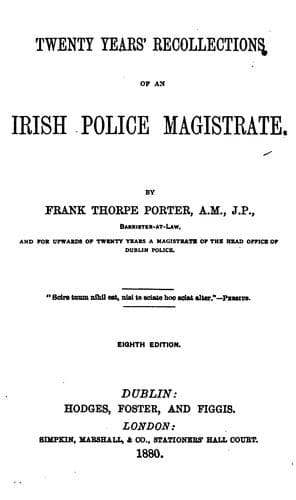
Twenty Years' Recollections of an Irish Police MagistratePorter, Frank Thorpe
History
Twenty Years' Recollections of an Irish Police Magistrate
Porter, Frank Thorpe
Crime -- Ireland; Criminals -- Ireland; Ireland -- Social life and customs; Porter, Frank Thorpe, 1801-1882
The "Hyacinth" never reached her destined port. Her fate was
conjectured, but was not ascertained, as it would be in the present time
of superior arrangements in agency and communication. Her owners
received their insurance as for a total loss, and James Wilson believed
that his hapless son had been entombed in the ocean.
At the commencement of the war between England and her revolted colonies
of North America, two commissioners were sent out, in the hope that
differences might be reconciled and peace restored. The Earl of Carlisle
and Mr. Eden (afterwards Lord Auckland) were proceeding on this mission
in a frigate, and after having encountered very stormy weather, they
fell in with a boat in which were several persons, reduced to the utmost
extremity by hunger and fatigue. They were rescued, and recovered their
strength by rest and nutrition. All, except one, were sailors, and they
were, perhaps very summarily, added to the frigate's crew. The landsman
was of a melancholy temperament, although young and naturally strong. He
was, however, of an humble and unpresuming manner, which did not
indicate vulgarity or ignorance. He expressed a desire to make himself
useful, cleaned some watches for the officers, and kept the plate of
their mess in proper order. Curiosity induced Lord Carlisle to accost
him, and the communication resulted in several acts of kindness on the
part of the nobleman, which were respectfully and gratefully, and
perhaps it may be said, gracefully, received. His Lordship's interest in
the poor shipwrecked fellow increased; and on their arrival in America,
he obtained for his protégé, from Sir Henry Clinton, an ensigncy in the
army.
Meanwhile Christian Wilson was forgotten in Skinner Row by all except
one. They had "mourned him dead in his father's _house_." His family
never adverted to his fate, for the subject was of painful recollection
in more senses than one. But Mary Tudor, although she seldom spoke of
Christian, would not admit that he was dead. Suitors for her hand were
numerous, but to none would she give the slightest encouragement, and
Delancy soon discovered that indifference was too mild a term to
describe her feeling towards him. Some years had passed. Her father had
attained complete senectude, but was still sound in mind and hale in
body. He lived happily with his daughter, who consulted his wishes on
every subject, except his anxiety to see her married in comfort and
respectability before he died. She had attained to her twenty-fifth or
twenty-sixth year, and she was particularly intimate with the family of
the person from whom this narrative is derived. In fact, it was her only
intimacy, and in her intercourse with them she frequently avowed her
conviction that the "lost one" would return.
Public-domain text, read in full here on John Shaqi.
Reviews
Reviews
No reviews yet
Be the first to share your thoughts on this work.
Join the Discussion
Join the discussion
Sign in to leave a comment or review.
Sign InorCreate an account