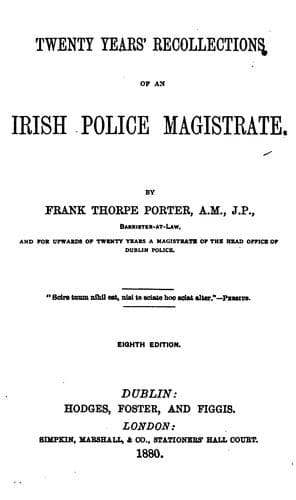
Twenty Years' Recollections of an Irish Police MagistratePorter, Frank Thorpe
History
Twenty Years' Recollections of an Irish Police Magistrate
Porter, Frank Thorpe
Crime -- Ireland; Criminals -- Ireland; Ireland -- Social life and customs; Porter, Frank Thorpe, 1801-1882
One morning a note was received by my father, requesting him to call, as
soon as possible, on the writer, at the Queen's Head Hotel in Bride
Street. He repaired to the place appointed; and in consequence of what
there occurred, he had interviews next morning with Richard Tudor and
James Wilson, and prevailed on them to accompany him to Cork Hill, about
11.30 a.m., and there he pointed out to the astonished and delighted old
men Captain Christian Wilson, of the 60th Regiment, marching his company
to relieve the guard at Dublin Castle.
The tale concludes. The lovers met and were united. Old Tudor was rich;
his closing years were happy. Wilson retired from the army after he had
attained the rank of Major, and settled on a property in a southern
county, where the descendants of him and Mary Tudor are living in
independence and respectability.
This narrative has been closely criticised. It has been asked, Did the
hero of the tale keep his very existence concealed so long, and why?
Suspicions have been expressed that the lovers had some communication or
correspondence. Whatever conjectures may be entertained, they need not
be canvassed here. The reader may form his own opinion. Much was said on
the subject, and something was even sung. The following verses are a
portion of a lyric attributed to a Mr. Rooney, a basket-maker in
Fishamble Street. The Tholsel guard, to the somnolent tendencies of
which an allusion is made, were in number about a dozen. They were
dressed in blue with orange facings, and armed with pole-axes. An
alderman of the time sarcastically described them as "selected for their
age and infirmities, and not required to be awake unless at their
meals."
"Some folk averr'd a bird was heard
To Mary's casement nigh;
And from its throat there thrill'd the note,
He's coming by-and-by.
"Some said there came, with war-worn frame,
A vet'ran grenadier,
Who spoke of one that led him on
Through battle's fierce career.
"Some said between them both had been
Of love notes not a few,
But this was clear, he did appear,
And wed his maiden true.
"Through Skinner Row the toast must go,
And our cheers reach Christ Church Yard,
Till its vaults profound send back the sound,
To waken the Tholsel guard.
"Here's to their health in peace and wealth;
May Death, that bold intruder,
A long while pause ere he lays his claws
On such as MARY TUDOR."
FOOTNOTE:
[2] In the old "Tholsel" or Guildhall of Dublin, members who had served
the office of Sheriff, or who represented the Guild of Merchants,
occupied the centre of the Council chamber. The members representing
incorporated trades sat next the wainscot. They had the reputation of
being the most independent members of the Corporation.
CHAPTER IV.
THE BIRTH OF A WORD--A LETTER OF INTRODUCTION--THE HONOR OF KNIGHTHOOD.
Public-domain text, read in full here on John Shaqi.
Reviews
Reviews
No reviews yet
Be the first to share your thoughts on this work.
Join the Discussion
Join the discussion
Sign in to leave a comment or review.
Sign InorCreate an account