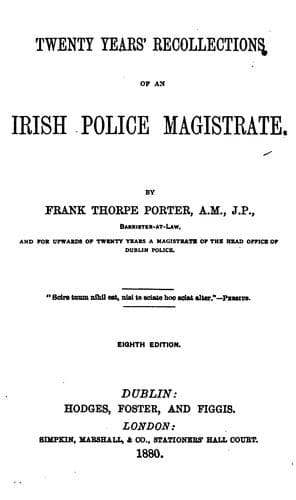
Twenty Years' Recollections of an Irish Police MagistratePorter, Frank Thorpe
History
Twenty Years' Recollections of an Irish Police Magistrate
Porter, Frank Thorpe
Crime -- Ireland; Criminals -- Ireland; Ireland -- Social life and customs; Porter, Frank Thorpe, 1801-1882
I have mentioned in the narrative respecting Lonergan, that my father
was a member of the corps of Dublin Volunteers, and that he was serjeant
of the grenadier company. Many of his comrades were living within my
memory, and I could name five or six who derived great gratification
from reverting to the period when the citizen soldiers of Ireland were
enrolled in thousands for the purpose of resisting an invasion which was
threatened by the French. The reviews, parades, and convivial
associations of the Volunteers afforded many agreeable recollections;
and I have heard from different narrators the same account of what may
be termed the birth of a word which originated in Eustace Street,
Dublin, upon the same day that ushered into this breathing world the
oldest and highest of rank amongst the Irish nobility.[3] I indulge in a
hope that my readers may consider the circumstances under which a word
was added to our language as curious or interesting, especially when
they are apprised that it was not taken from any other language, ancient
or modern, and yet it has become ubiquitous.
On the 21st of August, 1791, news had arrived in Dublin that Her Grace
the Duchess of Leinster had given birth to a young Marquis of Kildare.
To all ranks of society the intelligence was welcome, but especially to
the Volunteers. The Duke was the general of that force in his province,
but his own corps, of which he was colonel, was the Dublin one. Along
with the announcement of the accouchement of the Duchess, came an
intimation, that the corps would be expected at Carton on the happy
occasion of the christening. The opportunity for paying a compliment to
their commander was hailed by the citizen-soldiers with the utmost
enthusiasm, and there was a numerous gathering of them, to learn the
particulars and to consider their arrangements, at a tavern in Eustace
Street, Dublin, kept by a person named Bennett, and known as "The
Eagle." The evening had, as might be expected, a convivial termination.
Several who had attained to high civic dignities were amongst those
assembled; and there was also present Richard Daly, the proprietor and
manager of the Smock Alley theatre, who had an extraordinary propensity
for making wagers in reference to incidental matters, however
unimportant. In the course of the evening some casual opinions were
expressed on the histrionic powers of an actor named Sparkes, who was
then drawing immense houses in Daly's theatre. One of the Volunteers,
named Delahoyde, expressed his surprise that such crowds should run
after Sparkes, and remarked that his popularity was more the result of
fashionable caprice than of histrionic merits. "He is, in my opinion,"
added the speaker, "just what the French would term _un fagotin_." "And
what is the exact meaning of that word?" asked Alderman Moncrieffe.
"There is, perhaps, no one word in the English Language which conveys
its meaning exactly," said the interrogated party. "If I could give an
Public-domain text, read in full here on John Shaqi.
Reviews
Reviews
No reviews yet
Be the first to share your thoughts on this work.
Join the Discussion
Join the discussion
Sign in to leave a comment or review.
Sign InorCreate an account