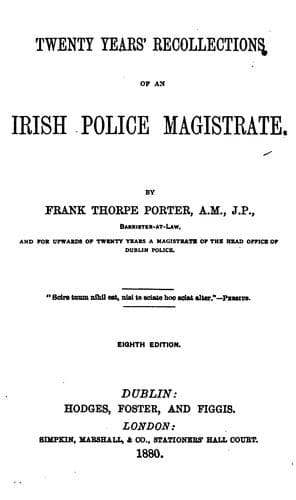
Twenty Years' Recollections of an Irish Police MagistratePorter, Frank Thorpe
History
Twenty Years' Recollections of an Irish Police Magistrate
Porter, Frank Thorpe
Crime -- Ireland; Criminals -- Ireland; Ireland -- Social life and customs; Porter, Frank Thorpe, 1801-1882
by the law, as it then existed, as more aggravated than murder, inasmuch
as he was in the domestic service of the man whom he was alleged to have
destroyed. He succeeded, on certain legal grounds, in postponing his
trial; but in the ensuing term a writ of _certiorari_ issued, and the
indictment was removed to the Court of King's Bench. A trial at bar was
held on November 12th, 1781, the jury having been brought up from
Kilkenny. The prisoner was convicted, and sentenced to be hanged and
_quartered_ on the 24th of the aforesaid month, and the sheriffs of the
City of Dublin were directed to have the sentence carried into effect.
At the time of his conviction, the prisoner declared that he was
innocent of the crime; but he admitted that he bought arsenic at the
instance of Mrs. O'Flaherty, who, according to his statement, told him
that she intended to use it in destroying rats. He did not deny the
imputation of an adulterous intrigue with her. The Rev. Mr. M'Kenna did
not forget his former pupil and assistant. He visited him in prison,
testified to his character in very favorable terms at the trial, and,
after condemnation, was assiduous in preparing him to meet his impending
doom with Christian resignation. He determined to attend him to the
termination of his sufferings, and to pay the last duties to his
remains. M'Kenna was married to a cousin of my father, and he was on
terms of the closest intimacy with our family. My father resided in
Skinner Row, (now Christ Church Place,) Dublin; and at the period to
which this narrative refers, he was in the prime of life--tall,
vigorous, and active. He was also serjeant of the grenadier company of
the Dublin Volunteers. He had known the unhappy Lonergan during the
peaceful and comparative innocent days that the latter had spent at
Raheny. He pitied the miserable fate of the culprit, doubted his guilt,
and sympathized with the worthy man whose pious solicitude and
friendship still sought to console the spirit that was so soon to pass
away. On the evening before the execution, M'Kenna remained with the
condemned as long as the regulations of the prison permitted. He then
betook himself to my father's house, where he proposed to stay until the
earliest hour of the morning at which he could be admitted to the gaol.
Having mentioned that he would not fail to attend Lonergan to the
consummation of his fate, in compliance with the culprit's request, he
was informed by my father that he should also be at the execution, for
that owing to the paucity of regular troops in Dublin, the sheriff had
made a requisition for a guard of the Volunteers, and that the grenadier
company were to attend at Baggot Street, (the Tyburn of Dublin,) to
which place the prisoner was to be escorted from Thomas Street by a
troop of cavalry.
Public-domain text, read in full here on John Shaqi.
Reviews
Reviews
No reviews yet
Be the first to share your thoughts on this work.
Join the Discussion
Join the discussion
Sign in to leave a comment or review.
Sign InorCreate an account