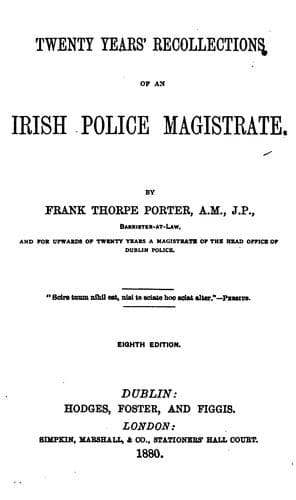
Twenty Years' Recollections of an Irish Police MagistratePorter, Frank Thorpe
History
Twenty Years' Recollections of an Irish Police Magistrate
Porter, Frank Thorpe
Crime -- Ireland; Criminals -- Ireland; Ireland -- Social life and customs; Porter, Frank Thorpe, 1801-1882
Accordingly, on the 24th November, 1781, Lonergan, having briefly but
very distinctly denied any participation in the crime for which he was
condemned, was hanged by the withdrawal of the cart from beneath the
gallows to which the halter was attached, and although he received no
drop, his sufferings did not seem to be very acute. He almost
immediately ceased to struggle, and life appeared to be extinct. The
weather was extremely inclement; and when the body had been suspended
for about twenty minutes, the sheriff acceded to a suggestion that it
might be cut down. There was some difficulty in getting at the rope so
as to cut it with a knife. M'Kenna remarked this to my father, who,
drawing his short, slightly curved, and very sharp hanger, directed the
cart to be backed towards the body. Then, springing up on the cart, he
struck the rope where it crossed the beam, and severed it at once. A
coffin was brought forward from a hearse which was in waiting. The
sheriff directed the cap to be removed, and the body to be turned with
the face down. Then he handed a sharp penknife to the executioner, who
made two incisions across each other on the back of the neck. This was
considered a formal compliance with the portion of the sentence which
directed "quartering." The body was then left to the care of the
faithful friend, M'Kenna, who directed it to be placed in the hearse and
conveyed to his house at Raheny. On the 26th, a funeral, very scantily
attended, proceeded to Raheny churchyard. M'Kenna had the coffin lowered
into a very deep grave, and the burial service was read by the parochial
clergyman. Persons were engaged to watch for a few nights lest any
attempt should be made to exhume the corpse for anatomical purposes. In
two days after the funeral my father received a note from M'Kenna, in
consequence of which he immediately proceeded to Raheny. On his arrival
he was pledged to secrecy and co-operation. He willingly assented, and
having been conducted into a small apartment in the upper part of the
house, he there beheld alive, although greatly debilitated, the man
whom, at Baggot Street, he had cut down from the gallows. On the night
of the 30th November, he brought Lonergan into Skinner Row. There he
kept him concealed for upwards of a week, and then succeeded in shipping
him for Bristol. From thence he proceeded, unsuspected and
uninterrupted, to America, where, under the name of James Fennell, he
lived for a considerable time, and supported himself by educational
pursuits. His resuscitation was attributed to the rope having been
unusually short, to his being swung from the cart without receiving any
perpendicular drop, and especially to the incisions in his neck, which
produced a copious effusion of blood. Lonergan stated that on being
suspended, he immediately lost any sensation of a painful nature. His
revival was attended with violent and distressing convulsions.
OLD PRISONS.
Public-domain text, read in full here on John Shaqi.
Reviews
Reviews
No reviews yet
Be the first to share your thoughts on this work.
Join the Discussion
Join the discussion
Sign in to leave a comment or review.
Sign InorCreate an account