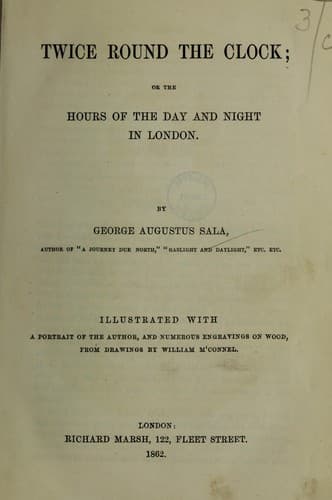
Twice round the clock; or, The hours of the day and night in LondonSala, George Augustus
General
Twice round the clock; or, The hours of the day and night in London
Sala, George Augustus
London (England) -- Social life and customs -- 19th century
King, who is lying mortally sick at Windsor, is dead. For it is within
a few minutes of eleven, and at that time the well-known troop of Horse
Guards pass on their way to St. James’s; and it is reasonably inferred
that, if King William be gathered to his fathers, the standard will be
furled. The Guards pass; they wore helmets, with plumes above them shaped
like black mutton chops—not the casques with the flowing horse-hair they
wear now; and to be sure the standard is furled, in a species of drab
umbrella case. The King is dead for sure; nay, he does not die for a full
week afterwards; the flag was merely furled because the day was dark and
lowering, presaging rain.
[Illustration: TWO O’CLOCK P.M.: REGENT STREET.]
I told you hours since that I lived in the house in Regent Street
in which the Marquis de Bourbel forged his letters of credit.[5] I
think that I am qualified to speak of the place, for, walking down it
the other day, I counted no less than eleven houses, between the two
circuses, in which I had at one time dwelt. But they were all early,
those remembrances, and connected with the time when the colonnade of
the Quadrant existed—“_La ville de Londres_,” as the foreign engravers
of pictorial note-paper used grandiloquently to call it. Whatever
could have possessed our Commissioner of Woods and Forests to allow
those unrivalled arcades to be demolished! The stupid tradesmen, whose
purblind, shop-till avarice led them to petition for the removal of the
columns, gained nothing by the change, for the Quadrant, as a lounge in
wet weather, was at once destroyed; and I see now many of the houses,
once let out in superior apartments, occupied as billiard-rooms and
photographic studios, and many of the shops invaded and conquered by
cheap tailors. The Quadrant colonnade afforded not only a convenient
shelter beneath, but it was a capital promenade for the dwellers in the
first-floors above. The _entresols_ certainly were slightly gloomy; and
moustached foreigners, together with some gaily-dressed company still
naughtier, could with difficulty be restrained from prowling backwards
and forwards between Glasshouse Street and the County Fire Office. But,
perambulating Regent Street at all hours of the day and night, as I do
now frequently, I see no diminution in the number of moustached, or
rouged, or naughty faces, whose prototypes were familiar to me, years
agone, in the brilliant Quadrant. As to the purlieus of the County Fire
Office, they are confusion, and a scandal to London and its police.
The first-floor balconies above were in my childhood most glorious
playgrounds. There I kept preserves of broken bottles and flowerpots; on
those leads I inscribed fantastic devices in chalk and with penknives,
drawing silver diagrams through the cake of dust and dried refrain that
covered the metal; and often have I come to domestic grief through an
irresistible propensity for poaching on the balconies of the neighbours
on either side.
Public-domain text, read in full here on John Shaqi.
Reviews
Reviews
No reviews yet
Be the first to share your thoughts on this work.
Elsewhere in the archive
Join the Discussion
Join the discussion
Sign in to leave a comment or review.
Sign InorCreate an account