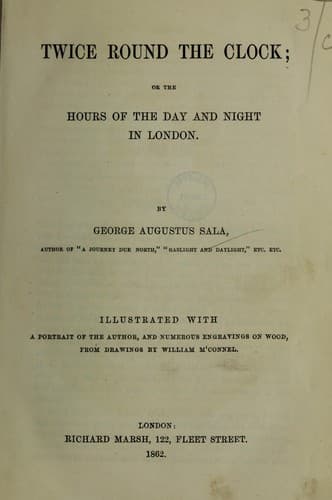
Twice round the clock; or, The hours of the day and night in LondonSala, George Augustus
General
Twice round the clock; or, The hours of the day and night in London
Sala, George Augustus
London (England) -- Social life and customs -- 19th century
Still in a state of tunic-hood, I remember a very tall,
handsome gentleman, with a crimson velvet under-waistcoat—I saw his
grave in Perè la Chaise last winter—who was my great aider and abettor
in these juvenile escapades. He had a wondrous weapon of offence called
a “sabar-cane,” a delightful thing (to me then), half walking-stick,
half pea-shooter, from which he used to discharge clay pellets at the
vagrant cats on the adjoining balconies. He it was who was wont to lean
over the balcony, and fish for people’s hats with a salmon-hook affixed
to the extremity of a tandem-whip; he it was who came home from the Derby
(quite in a friendly manner) to see us one evening, all white—white hat,
white coat, white trousers, white waistcoat, white neckerchief, white
boots, to say nothing of the dust and the flour with which he had been
plentifully besprinkled at Kennington Gate. He had won heavily on some
horse long since gone to grass for ever, was very merry, and insisted
upon winding-up our new French clock with the snuffers. He it was who
made nocturnal excursions from parapet to parapet along the leads,
returning with bewildering accounts of bearded men who were gambling
with dice at No. 92; of the tenor of the Italian Opera, who, knife in
hand, was pursuing his wife (in her nightdress) about the balcony, at
No. 74; and of Mademoiselle Follejambes, the _premier sujet_ of the same
establishment, who was practising _pirouettes_ before a cheval glass at
the open window of No. 86, while Mademoiselle Follejambe’s mamma, with
a red cotton pocket-handkerchief tied round her old head, was drinking
_anisette_ out of a tea-cup. You must be forbearing with me, if, while I
speak of Regent Street, I interlard my speech with foreign languages a
little. For, from its first erection, the Quadrant end of Regent Street
has been the home of the artistic foreigners who are attracted to London
during the musical and operatic season, less by inclination for the
climate and respect for the institutions of England, than by a profound
admiration for the circular effigies, in gold, (with neatly milled edges)
of her Majesty the Queen, which John Bull so liberally bestows on those
who squall or fiddle for him, provided they be of foreign extraction.
Let me not be too unjust, however, to Bull. Find him but a real English
tenor, and J. B. will smother him in bank-notes, and deafen him with
plaudits. From the balconies of Regent Street, I have seen the greatest
_cantatrici_ and _ballerine_ of this age. The Grand Cham of tenors,
who has _never_ been replaced—no signor Mario, no Signor Giuglini, no
Signor Mongini, no Signor Tamberlik, no Mr. Sims Reeves, no Mr. George
Perren—the incomparable Rubini, had lodgings opposite, once, to where
we dwelt, at a shawl shop. I have watched the sedulous care which that
eminent man took of his health, marvelled at the multitudinous folds
of silk or woollen stuff, like the turban of an Asiatic, with which he
Public-domain text, read in full here on John Shaqi.
Reviews
Reviews
No reviews yet
Be the first to share your thoughts on this work.
Elsewhere in the archive
Join the Discussion
Join the discussion
Sign in to leave a comment or review.
Sign InorCreate an account