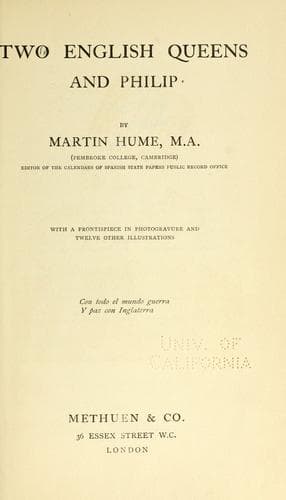
Two English queens and PhilipHume, Martin A. S. (Martin Andrew Sharp)
Philosophy
Two English queens and Philip
Hume, Martin A. S. (Martin Andrew Sharp)
The aid of France was, of course, a necessary condition
of success; but when the moment for action came Henry II. had just
signed the truce of Vaucelles, and he counselled prudence and a waiting
policy, knowing that the blow might be more effectually dealt when the
inevitable war recommenced. That Elizabeth was at least cognisant that
something was afoot is evident from Montmorenci’s letter to Noailles
of 7th February, 1556 (Ambassades, vol. v.), in which he says: “And,
above all, prevent Madam Elizabeth from moving in the slightest degree
to undertake what you say; for if she do it will spoil everything and
prevent the fruition of their designs, which must be deferred until a
good opportunity offers.”
The French Embassy in London became the rallying-point for treason
against Mary; crowds of disaffected Englishmen begged for means of
joining Dudley, who had gone to France, and there with French aid to
organise a descent upon England simultaneous with a rising at Court.
Noailles himself was an eager conspirator, but the French Government
advised delay, and the ambassador was obliged to temporise. The
conspirators were in no mood now for half-measures, for the country
was growing indignant at the religious persecutions and the unfounded
belief that Mary was impoverishing her country by sending out money to
her Spanish husband, and it was determined by the conspirators to act
at once. Sir Anthony Kingston, with the Devonshire men, was to march
to London, raising the country on the way; the Captain of the Isle of
Wight, Uvedale, was to place the island at the disposal of the English
refugees from France, whilst Heneage and other courtiers undertook to
raise London, pillage the treasury, and proclaim Elizabeth Queen. Pole
always distrusted Elizabeth, even in her most submissive and Catholic
moods; and, thanks to a spy, he had already been informed of the whole
plan of the conspirators; whilst Wotton, the English ambassador in
France, had kept the English Council well informed of the movements
and gossip of the English refugees. Just before the time fixed for the
rising, therefore, the hand of the Council came down heavily upon the
conspirators, and by the end of March all the principals found themselves
behind the bars, most of them on the way to the scaffold.
Public-domain text, read in full here on John Shaqi.
Reviews
Reviews
No reviews yet
Be the first to share your thoughts on this work.
Elsewhere in the archive
Join the Discussion
Join the discussion
Sign in to leave a comment or review.
Sign InorCreate an account