Dana, Richard Henry, 1815-1882; Sailors; Seafaring life; Voyages and travels
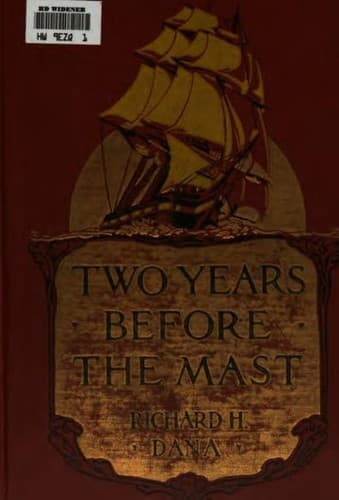
securing a painting of the Alert under full sail and other
illustrations, both colored and in pen and ink, faithful to the
text in every detail.
Accuracy, however, is not the secret of the success of this book.
Its flowing style, the use of short Anglo-Saxon words,[3] its
picturesqueness, the power of description, the philosophic
arrangement all contribute to it, but chiefly, I believe, the
enthusiasm of the young Dana, his sympathy for his fellows and
interest in new scenes and strange peoples, and with it all, the
real poetry that runs through the whole. As to its poetry, I will
quote from Mrs. Bancroft's ``Letters from England,'' giving the
opinion of the poet Samuel Rogers:
``London, June 20, 1847.
``The 19th, Sat. we breakfasted with Lady Byron and my friend Miss
Murray, at Mr. Rogers'. . . . After breakfast he had been
repeating some lines of poetry which he thought fine, when he
suddenly exclaimed, `But there is a bit of American prose, which,
I think, has more poetry in it, than almost any modern verse.' He
then repeated, I should think, more than a page from Dana's `Two
Years Before the Mast' describing the falling overboard of one of
the crew, and the effect it produced, not only at the moment, but
for some time afterward. I wondered at his memory, which enabled
him to recite so beautifully a long prose passage, so much more
difficult than verse. Several of those present, with whom the book
was a favorite, were so glad to hear from me that it was as true
as interesting, for they had regarded it as partly a work of
imagination.''
In writing the book Mr. Dana had a motive which inspired him to
put into it his very best. The night after the flogging of his two
fellow-sailors off San Pedro, California, Mr. Dana, lying in his
berth, ``vowed that, if God should ever give me the means, I would
do something to redress the grievances and relieve the sufferings
of that class of beings with whom my lot has been so long cast.''
This vow he carried out in no visionary scheme of mutiny or
foolish ``paying back'' to the captain, but by awakening a
``strong sympathy'' for the sailors ``by a voice from the
forecastle,'' in his ``Two Years Before the Mast.''
Public-domain text, read in full here on John Shaqi.
Reviews
Reviews
No reviews yet
Be the first to share your thoughts on this work.
Join the Discussion
Join the discussion
Sign in to leave a comment or review.
Sign InorCreate an account