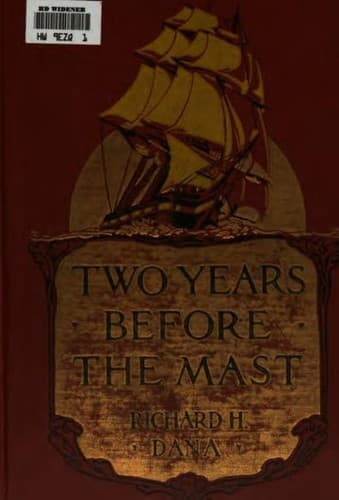
Dana, Richard Henry, 1815-1882; Sailors; Seafaring life; Voyages and travels
After they had got through with the hides, the Kanakas laid hold
of the bags of tallow (the bags are made of hide, and are about
the size of a common meal-bag), and lifted each upon the shoulders
of two men, one at each end, who walked off with them to the boat,
when all prepared to go aboard. Here, too, was something for us to
learn. The man who steered shipped his oar and stood up in the
stern, and those that pulled the two after oars sat upon their
benches, with their oars shipped, ready to strike out as soon as
she was afloat. The two men remained standing at the bows; and
when, at length, a large sea came in and floated her, seized hold
of the gunwales, and ran out with her till they were up to their
armpits, and then tumbled over the gunwales into the bows,
dripping with water. The men at the oars struck out, but it
wouldn't do; the sea swept back and left them nearly high and dry.
The two fellows jumped out again; and the next time they succeeded
better, and, with the help of a deal of outlandish hallooing and
bawling, got her well off. We watched them till they were out of
the breakers, and saw them steering for their vessel, which was
now hidden in the darkness.
The sand of the beach began to be cold to our bare feet; the frogs
set up their croaking in the marshes, and one solitary owl, from
the end of the distant point, gave out his melancholy note,
mellowed by the distance, and we began to think that it was high
time for ``the old man,'' as a shipmaster is commonly called, to
come down. In a few minutes we heard something coming towards us.
It was a man on horseback. He came on the full gallop, reined up
near us, addressed a few words to us, and, receiving no answer,
wheeled round and galloped off again. He was nearly as dark as an
Indian, with a large Spanish hat, blanket cloak or serape, and
leather leggins, with a long knife stuck in them. ``This is the
seventh city that ever I was in, and no Christian one neither,''
said Bill Brown. ``Stand by!'' said John, ``you haven't seen the
worst of it yet.'' In the midst of this conversation the captain
appeared; and we winded the boat round, shoved her down, and
prepared to go off. The captain, who had been on the coast
before, and ``knew the ropes,'' took the steering-oar, and we went
off in the same way as the other boat. I, being the youngest, had
the pleasure of standing at the bow, and getting wet through. We
went off well, though the seas were high. Some of them lifted us
up, and, sliding from under us, seemed to let us drop through the
air like a flat plank upon the body of the water. In a few minutes
we were in the low, regular swell, and pulled for a light, which,
as we neared it, we found had been run up to our trysail gaff.
Public-domain text, read in full here on John Shaqi.
Reviews
Reviews
No reviews yet
Be the first to share your thoughts on this work.
Join the Discussion
Join the discussion
Sign in to leave a comment or review.
Sign InorCreate an account