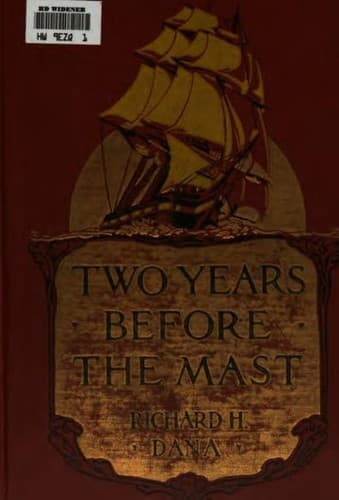
Dana, Richard Henry, 1815-1882; Sailors; Seafaring life; Voyages and travels
Coming aboard, we hoisted up all the boats, and, diving down into
the forecastle, changed our wet clothes, and got our supper. After
supper the sailors lighted their pipes (cigars, those of us who
had them), and we had to tell all we had seen ashore. Then
followed conjectures about the people ashore, the length of the
voyage, carrying hides, &c., &c., until eight bells, when all
hands were called aft, and the ``anchor watch'' set. We were to
stand two in a watch, and, as the nights were pretty long, two
hours were to make a watch. The second mate was to keep the deck
until eight o'clock, all hands were to be called at daybreak, and
the word was passed to keep a bright lookout, and to call the mate
if it should come on to blow from the southeast. We had, also,
orders to strike the bells every half-hour through the night, as
at sea. My watchmate was John, the Swedish sailor, and we stood
from twelve to two, he walking the larboard side and I the
starboard. At daylight all hands were called, and we went through
the usual process of washing down, swabbing, &c., and got
breakfast at eight o'clock. In the course of the forenoon, a boat
went aboard of the Ayacucho and brought off a quarter of beef,
which made us a fresh bite for dinner. This we were glad enough to
have, and the mate told us that we should live upon fresh beef
while we were on the coast, as it was cheaper here than the salt.
While at dinner, the cook called ``Sail ho!'' and, coming on deck,
we saw two sails bearing round the point. One was a large ship
under top-gallant sails, and the other a small hermaphrodite brig.
They both backed their topsails and sent boats aboard of us. The
ship's colors had puzzled us, and we found that she was from
Genoa, with an assorted cargo, and was trading on the coast. She
filled away again, and stood out, being bound up the coast to San
Francisco. The crew of the brig's boat were Sandwich-Islanders,
but one of them, who spoke a little English, told us that she was
the Loriotte, Captain Nye, from Oahu, and was engaged in the hide
and tallow trade. She was a lump of a thing, what the sailors call
a butter-box. This vessel, as well as the Ayacucho, and others
which we afterwards saw engaged in the same trade, have English or
Americans for officers, and two or three before the mast to do the
work upon the rigging, and to be relied upon for seamanship, while
the rest of the crew are Sandwich-Islanders, who are active and
very useful in boating.
Public-domain text, read in full here on John Shaqi.
Reviews
Reviews
No reviews yet
Be the first to share your thoughts on this work.
Join the Discussion
Join the discussion
Sign in to leave a comment or review.
Sign InorCreate an account