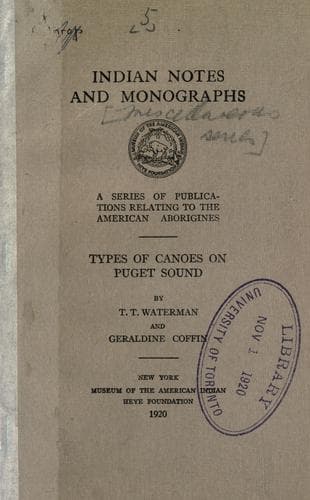
Types of canoes on Puget SoundWaterman, T. T. (Thomas Talbot)
History
Types of canoes on Puget Sound
Waterman, T. T. (Thomas Talbot)
Canoes and canoeing; Indians of North America -- Boats; Indians of North America -- History
Seated in place like the bow-piece, mentioned above.
_On the Exterior of the Hull_
9. Narrow piece projecting forward at the tip of the prow, _bΔ´qsιd_.
The shape of the forward part of the bow-piece strongly suggests
the head of some living creature. The projection would correspond
to a snout or beak. The Indians say the resemblance is accidental.
10. A knob or projection on the neck of the canoe, about two feet below
the preceding feature, _bla´lgwa’_.
This word means “navel.” The Makah call this projection the boa1’s
uvula.
11. Ornamentation consisting of parallel lines, incised with a special
tool, like a reamer, on the side of the neck, _astc_ι´_1’absub_.
This is incised with a special tool, in the old days made of flint,
resembling a reamer. This ornamentation is found also on the top
surface of the bow-piece.
12. Curved line of the prow, _cli´bus_.
13. Cutwater, _tL’kwa´psΔb_.
14. A bulge or raised strip at the gunwale, _stLaa´gwΔp_.
A corresponding excavation on the inside of the hull is mentioned
below (No. 23).
15. Bottom, _1’a´tsΔp_.
16. Where the bottom turns up toward the gunwale to form the sides,
_cΔxdt1’a´ladi_.
17. Sharp blade or half-keel, under the cano1’s forefoot, _st’ιtci´bιt_.
This acts as a “muffler.” It cuts into the waves as the canoe
forges ahead, without splashing. The canoe moves silently.
18. Forward extremity of the half-keel, _1’ilqs_.
_On the Interior of the Hull_
19. Interior of the canoe, _xuxta´ts_.
20. Where the bottom turns up to form the sides, _wila´ladiL_.
21. Offset where the canoe widens at the gunwale, _stpu´tsid_.
This corresponds to the _stLaa´gwΔp_ (No. 14 above).
22. Side of the canoe, _i´lalgwιL_.
23. Trench leading sternward from the tip of the prow, _sxwο´qbus_.
24. Vertical line of the hull at the stern, _stLkwa´·lap_.
_Additional Fittings_
25. Thwarts, _cxalwi´ld_.
These are round poles instead of flat benches, as in the canoes of
Alaska and in our own boats. When on a trip the Indians pad them
with an old mat, folded.
26. Withes of twisted cedar limbs, which fasten the thwarts,
_cli´dclidgΔs_.
They are rove through a perforation in the thwart, and then through
perforations in the side of the boat. Similar withes are used for
mending cracks and in fastening the bow and stern sections in place
(see No. 7 above). The present word refers to the way in which they
are manipulated in fastening thwarts in place.
27. Strip of wood along the gunwale, _stL’a´lalgwιL_.
This is pegged to the top surface of the gunwale, to where the
paddles rub, to prevent the sides of the canoe from being worn.
28. Painter, or boat rope, _LΔdgwi´lad_.
Used for mooring the boat, or anchoring it.
29. Crack in the hull, _actcΔ´x_.
30. Knot-hole, _st1’a´ctalus_ (knot, _stcact_).
31. “Patched place,” _stΔka´lgwιL_.
Public-domain text, read in full here on John Shaqi.
Reviews
Reviews
No reviews yet
Be the first to share your thoughts on this work.
Join the Discussion
Join the discussion
Sign in to leave a comment or review.
Sign InorCreate an account