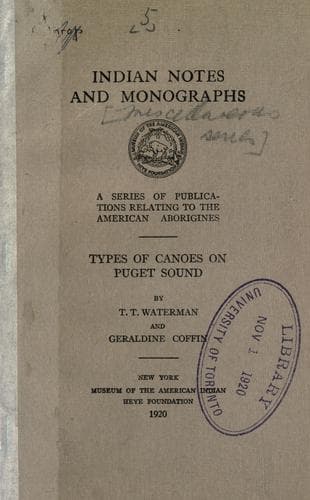
Types of canoes on Puget SoundWaterman, T. T. (Thomas Talbot)
History
Types of canoes on Puget Sound
Waterman, T. T. (Thomas Talbot)
Canoes and canoeing; Indians of North America -- Boats; Indians of North America -- History
When the side of a canoe is broken, a section is cut out bodily, a
piece of plank being carefully shaped to fit in the space. This
plank is fastened in place with cedar pegs and by “sewing” with
cedar withes.
32. A “long patch,” _sΔp1’a´tsgwιL_.
This term refers to a place where a longitudinal crack in the
bottom of the hull has been closed by stitching it up with cedar
withes.
33. Holes bored in making the canoe, to test the thickness of the sides,
_udtc’ι´stΔd_.
These holes are later closed by plugging them with round pegs of
maple, which swells greatly on being wet.
34. Mast, _xputdale_ (cf. _pu´tιd_, sail).
Informants insist that masts and sails are aboriginal. Vancouver,
writing in 1792, says they are not.
35. Step or socket for the mast, _tcugwacα´gwΔp_.
36. Sail, _pu´tιd_.
This was a “square” sail, of checker-work matting, and was hoisted
only when the breeze happened to come directly over the stern.
37. Upper yard, _taLa´Lqud_.
38. Lower yard, _tLi´dΔp_.
39. Paddle, _xobt_.
_Terms of Direction_
40. Ahead, _tudzi´q^{w}_.
41. Astern, _tuxula´q^{w}_.
42. Starboard, or right side, _dzaha´lgwisapΔp_.
43. Port, or left side, _kala´lgwisapΔp_.
44. Forward, _tuca´dst_ (cf. _cεdst_, bow).
45. Aft, _tue´laq_ (cf. _i´laaq_, stern).
46. Amidships, _o´dugwιL_.
Linguistically there is evident similarly between certain of the words
in this list, as shown by the following groups:
(5) Bow-piece, _stL’a´lu_.
(8) Stern-piece, _stL’a´lalΔp_.
(13) Cutwater, _tL’kwa´psΔb_ (cf. especially No. 26 below).
(14) Raised strip along gunwale, _stLaa´gwΔp_.
(24) Vertical line at stern, _stLkwa´·lap_.
(27) Strip pegged to gunwale, _stL’a´lalgwιL_.
(6) Dowels, or pegs, _st’Δ´stΔd_.
(33) Holes bored to test the thickness of the hull, _udtc’ι´stΔd_.
One is inclined to suspect the presence of a common suffix in the
following cases:
(12) Curved line of the prow, _cli´bus_.
(23) Trench leading backward from the prow, _sxwο´qbus_.
The presence of a suffix is obvious in the following cases:
(3) Side, _sila´lgwil_.
(4) Gunwale, _sbΔtctca´lgwil_.
(22) Side of the canoe (interior), _i´lalgwιL_.
(31) Section of plank used as a patch, _stΔka´lgwιL_.
(32) Closing of a crack by sewing, _sΔp1’a´tsgwιL_.
(11) Ornamental lines, _astcι´1’absub_.
(13) Cutwater, _tL’kwa´psΔb_.
(15) Bottom, _1’a´tsΔp_.
Analysis of these expressions is not possible at the present time.
The terms in the above list apply especially to the sea-going canoe.
Similar words are applied to the other types of canoes, except where the
corresponding parts are missing.
The notch at the bow of the trolling canoe is simply called _qa´dxu_,
“notch.”
DISTRIBUTION OF THE VARIOUS TYPES
Public-domain text, read in full here on John Shaqi.
Reviews
Reviews
No reviews yet
Be the first to share your thoughts on this work.
Join the Discussion
Join the discussion
Sign in to leave a comment or review.
Sign InorCreate an account