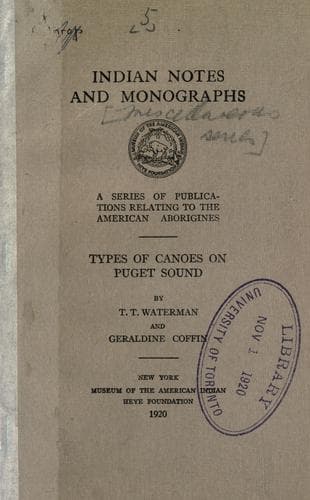
Types of canoes on Puget SoundWaterman, T. T. (Thomas Talbot)
History
Types of canoes on Puget Sound
Waterman, T. T. (Thomas Talbot)
Canoes and canoeing; Indians of North America -- Boats; Indians of North America -- History
GERALDINE COFFIN
NEW YORK
MUSEUM OF THE AMERICAN INDIAN
HEYE FOUNDATION
1920
This series of INDIAN NOTES AND MONOGRAPHS is devoted primarily to the
publication of the results of studies by members of the staff of the
Museum of the American Indian, Heye Foundation, and is uniform with
HISPANIC NOTES AND MONOGRAPHS, published by the Hispanic Society of
America, with which organization this Museum is in cordial coöperation.
TYPES OF CANOES ON
PUGET SOUND
BY
T.T. WATERMAN
AND
GERALDINE COFFIN
CONTENTS
PAGE
Introduction 7
Specialization of the North Pacific Canoe
into Different Models 10
Points of Interest in the Various Types 14
The War Canoe 14
The “Freight Canoe” 17
The “Trolling Canoe” 18
The “Shovel-nose Canoe” 19
The “One-man Canoe” 21
The “Children’s Canoe” 22
Native Terms for the Parts of the Canoe 23
Distribution of the Various Types 29
Conclusions 36
Bibliography 39
Notes 42
TYPES OF CANOES ON PUGET SOUND
BY
T.T. WATERMAN AND GERALDINE COFFIN
INTRODUCTION
The canoes and the canoe manufacture of the North Pacific area have
already received a fair amount of attention in ethnographical
literature.[1] Many sizes and shapes of craft are in use, most of which
have not been described in detail. All North Pacific canoes from Mount
St Elias in Alaska to Eel river in northern California are, to quote the
_Handbook_,[2] of a dugout type. The area of Puget sound lies in a
general way toward the center of this region, and in this vicinity the
largest variety of canoes seems to be in use. Our present purpose is to
describe the types of canoes found at the present time on Puget sound
proper, and then to outline, so far as is possible on the basis of
scanty information, the distribution of these types into other regions.
The specimens on which this discussion is based were collected for the
Museum of the American Indian, Heye Foundation, in the immediate
vicinity of Seattle. The native terms for the various models and for the
parts of the canoes are in the “Duwamish” dialect of Salish. The sounds
occurring in this and the other Salish dialects spoken on the upper part
of Puget sound are represented in the following tabulation.
VOWELS
i, ι u, υ
e, ε o, ↄ
Δ
α a
Public-domain text, read in full here on John Shaqi.
Reviews
Reviews
No reviews yet
Be the first to share your thoughts on this work.
Join the Discussion
Join the discussion
Sign in to leave a comment or review.
Sign InorCreate an account