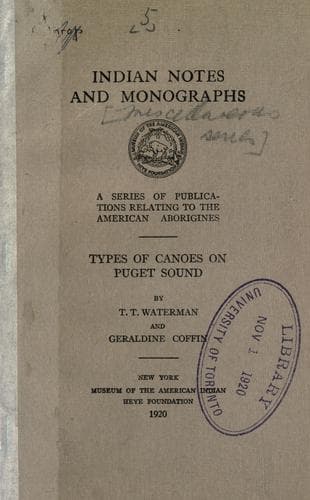
Types of canoes on Puget SoundWaterman, T. T. (Thomas Talbot)
History
Types of canoes on Puget Sound
Waterman, T. T. (Thomas Talbot)
Canoes and canoeing; Indians of North America -- Boats; Indians of North America -- History
i, as in _machine_
ι, as in _pin_
e, as in _fête_
ε, as in _met_
α, as in _hat_
Δ, as in _but_
u, as in _rule_
υ, as in _full_
o, as in _note_
ↄ, as ou in _ought_
a, as in _bar_
DIPHTHONGS
ai, as in _aisle_
oi, as in _boil_
SEMIVOWELS
w, y, substantially as in English
CONSONANTS
---------------------+-----------+----------+-----------+-------+-----------|
_Stop_ |Labialized |Continuant|Affricative|Lateral|Affricative|
| stop | | | | lateral |
---------------------+---+-------+----------+-----+-----+---+---+---+-------|
| | S | F | | F | | | F | |S | | F |
| | o | o | | o | | | o | |o | | o |
|S | n | r |S | r | S | S | r |S |n |S | r |
|u | a | t |u | t | u | u | t |u |a |u | t |
|r | n | i |r | i | r | r | i |r |n |r | i |
|d | t | s |d | s | d | d | s |d |t |d | s |
----------|--|---|---|---|-------|----------|-----|-----|---|---|---|-------|
_Labial_ |p | b | p’| | | | | | | | | |
_Dental_ |t | d | t’| | | s | ts | ts’|L | l |tL | tL’ |
_Alveolar_| | | | | | c | tc | tc’| | | | |
_Palatal_ |k | g | g’|kw | kw’ | | | | | | | |
_Velar_ |q | γ | q’|qw | qw’ | | | | | | | |
_Glottal_ | ’| | | | |h,´ | | | | | | |
----------|--|---|---|---|-------|----------|-----|-----|---|---|---|-------|
Of these sounds the following need, for the casual reader, some
explanation. Surd _l_ (written _L_) is an _l_ produced without the help
of the vocal cords. The symbol _c_ has approximately the value of _sh_
in _she_. The digraph _tc_ is sounded like _ch_ in _church_. The symbols
in those columns which are headed “fortis” represent exploded or cracked
consonants, produced with hard pressure of the tongue, followed by an
abrupt release. The sound is quite sharp, markedly different from
anything in English. The “velar” sounds likewise seem quite strange to
English-speaking people; they are produced by making contact between the
tongue and the back part of the palate (the velum). The glottal stop (’)
represents a catch which checks the breath in the throat (larynx). Two
sounds resembling English _h_ seem to exist, one of them very weak,
represented here by ^{c}. Superior letters represent whispered or weakly
articulated sounds.
SPECIALIZATION OF THE NORTH PACIFIC CANOE INTO DIFFERENT MODELS
Public-domain text, read in full here on John Shaqi.
Reviews
Reviews
No reviews yet
Be the first to share your thoughts on this work.
Join the Discussion
Join the discussion
Sign in to leave a comment or review.
Sign InorCreate an account