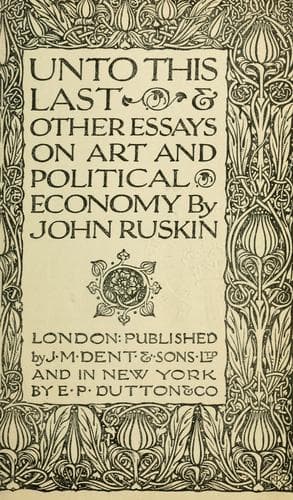
Unto This Last, and Other Essays on Political EconomyRuskin, John
General
Unto This Last, and Other Essays on Political Economy
Ruskin, John
Art; Economics
Nay, but you reply, there is one vast difference between the nation's
economy and the private man's: the farmer has full authority over his
labourers; he can direct them to do what is needed to be done, whether
they like it or not; and he can turn them away if they refuse to work,
or impede others in their working, or are disobedient, or quarrelsome.
There _is_ this great difference; it is precisely this difference on
which I wish to fix your attention, for it is precisely this
difference which you have to do away with. We know the necessity of
authority in farm, or in fleet, or in army; but we commonly refuse to
admit it in the body of the nation. Let us consider this point a
little.
In the various awkward and unfortunate efforts which the French have
made at the development of a social system, they have at least stated
one true principle, that of fraternity or brotherhood. Do not be
alarmed; they got all wrong in their experiments, because they quite
forgot that this fact of fraternity implied another fact quite as
important--that of paternity or fatherhood. That is to say, if they
were to regard the nation as one family, the condition of unity in
that family consisted no less in their having a head, or a father,
than in their being faithful and affectionate members, or brothers.
But we must not forget this, for we have long confessed it with our
lips, though we refuse to confess it in our lives. For half an hour
every Sunday we expect a man in a black gown, supposed to be telling
us truth, to address us as brethren, though we should be shocked at
the notion of any brotherhood existing among us out of church. And we
can hardly read a few sentences on any political subject without
running a chance of crossing the phrase "paternal government," though
we should be utterly horror-struck at the idea of governments claiming
anything like a father's authority over us. Now, I believe those two
formal phrases are in both instances perfectly binding and accurate,
and that the image of the farm and its servants which I have hitherto
used, as expressing a wholesome national organization, fails only of
doing so, not because it is too domestic, but because it is not
domestic enough; because the real type of a well-organized nation must
be presented, not by a farm cultivated by servants who wrought for
hire, and might be turned away if they refused to labour, but by a
farm in which the master was a father, and in which all the servants
were sons; which implied, therefore, in all its regulations, not
merely the order of expediency, but the bonds of affection and
responsibilities of relationship; and in which all acts and services
were not only to be sweetened by brotherly concord, but to be enforced
by fatherly authority.[3]
[3] See note 1st, in Addenda [p. 86].
Public-domain text, read in full here on John Shaqi.
Reviews
Reviews
No reviews yet
Be the first to share your thoughts on this work.
Join the Discussion
Join the discussion
Sign in to leave a comment or review.
Sign InorCreate an account