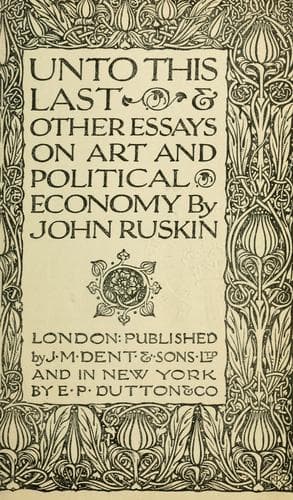
Unto This Last, and Other Essays on Political Economy — John Shaqi
Unto This Last, and Other Essays on Political EconomyRuskin, John
General
Unto This Last, and Other Essays on Political Economy
Ruskin, John
Art; Economics
Now, the precise counterpart of such a household would be seen in a
nation in which political economy was rightly understood. You complain
of the difficulty of finding work for your men. Depend upon it, the
real difficulty rather is to find men for your work. The serious
question for you is not how many you have to feed, but how much you
have to do; it is our inactivity, not our hunger, that ruins us: let
us never fear that our servants should have a good appetite--our
wealth is in their strength, not in their starvation. Look around this
island of yours, and see what you have to do in it. The sea roars
against your harbourless cliffs--you have to build the breakwater, and
dig the port of refuge; the unclean pestilence ravins in your
streets--you have to bring the full stream from the hills, and to send
the free winds through the thoroughfare; the famine blanches your lips
and eats away your flesh--you have to dig the moor and dry the marsh,
to bid the morass give forth instead of engulphing, and to wring the
honey and oil out of the rock. These things, and thousands such, we
have to do, and shall have to do constantly, on this great farm of
ours; for do not suppose that it is anything else than that. Precisely
the same laws of economy which apply to the cultivation of a farm or
an estate apply to the cultivation of a province or of an island.
Whatever rebuke you would address to the improvident master of an
ill-managed patrimony, precisely that rebuke we should address to
ourselves, so far as we leave our population in idleness and our
country in disorder. What would you say to the lord of an estate who
complained to you of his poverty and disabilities, and, when you
pointed out to him that his land was half of it overrun with weeds,
and that his fences were all in ruin, and that his cattle-sheds were
roofless, and his labourers lying under the hedges faint for want of
food, he answered to you that it would ruin him to weed his land or to
roof his sheds--that those were too costly operations for him to
undertake, and that he knew not how to feed his labourers nor pay
them? Would you not instantly answer, that instead of ruining him to
weed his fields, it would save him; that his inactivity was his
destruction, and that to set his labourers to work was to feed them?
Now, you may add acre to acre, and estate to estate, as far as you
like, but you will never reach a compass of ground which shall escape
from the authority of these simple laws. The principles which are
right in the administration of a few fields, are right also in the
administration of a great country from horizon to horizon: idleness
does not cease to be ruinous because it is extensive, nor labour to be
productive because it is universal.
Public-domain text, read in full here on John Shaqi.
Reviews
Reviews
No reviews yet
Be the first to share your thoughts on this work.
Join the Discussion
Join the discussion
Sign in to leave a comment or review.
Sign InorCreate an account