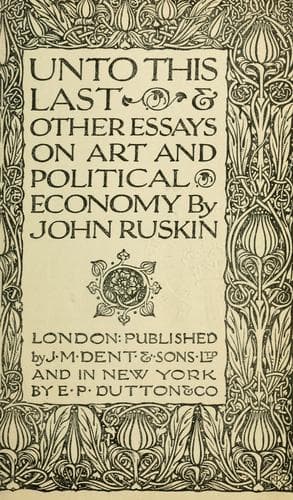
Unto This Last, and Other Essays on Political EconomyRuskin, John
General
Unto This Last, and Other Essays on Political Economy
Ruskin, John
Art; Economics
This inapplicability has been curiously manifested during the
embarrassment caused by the late strikes of our workmen. Here occurs
one of the simplest cases, in a pertinent and positive form, of the
first vital problem which political economy has to deal with (the
relation between employer and employed); and at a severe crisis, when
lives in multitudes, and wealth in masses, are at stake, the political
economists are helpless--practically mute; no demonstrable solution of
the difficulty can be given by them, such as may convince or calm the
opposing parties. Obstinately the masters take one view of the
matter; obstinately the operatives another; and no political science
can set them at one.
It would be strange if it could, it being not by "science" of any kind
that men were ever intended to be set at one. Disputant after
disputant vainly strives to show that the interests of the masters
are, or are not, antagonistic to those of the men: none of the
pleaders ever seeming to remember that it does not absolutely or
always follow that the persons must be antagonistic because their
interests are. If there is only a crust of bread in the house, and
mother and children are starving, their interests are not the same. If
the mother eats it, the children want it; if the children eat it, the
mother must go hungry to her work. Yet it does not necessarily follow
that there will be "antagonism" between them, that they will fight for
the crust, and that the mother, being strongest, will get it, and eat
it. Neither, in any other case, whatever the relations of the persons
may be, can it be assumed for certain that, because their interests
are diverse, they must necessarily regard each other with hostility,
and use violence or cunning to obtain the advantage.
Even if this were so, and it were as just as it is convenient to
consider men as actuated by no other moral influences than those which
affect rats or swine, the logical conditions of the question are still
indeterminable. It can never be shown generally either that the
interests of master and labourer are alike, or that they are opposed;
for, according to circumstances, they may be either. It is, indeed,
always the interest of both that the work should be rightly done, and
a just price obtained for it; but, in the division of profits, the
gain of the one may or may not be the loss of the other. It is not the
master's interest to pay wages so low as to leave the men sickly and
depressed, nor the workman's interest to be paid high wages if the
smallness of the master's profit hinders him from enlarging his
business, or conducting it in a safe and liberal way. A stoker ought
not to desire high pay if the company is too poor to keep the
engine-wheels in repair.
Public-domain text, read in full here on John Shaqi.
Reviews
Reviews
No reviews yet
Be the first to share your thoughts on this work.
Elsewhere in the archive
Join the Discussion
Join the discussion
Sign in to leave a comment or review.
Sign InorCreate an account