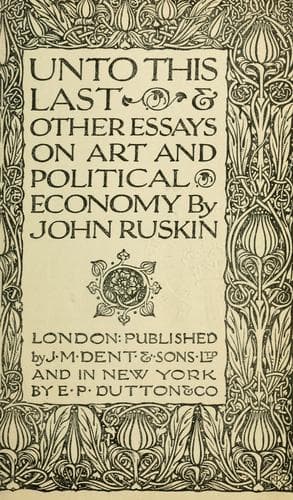
Unto This Last, and Other Essays on Political EconomyRuskin, John
General
Unto This Last, and Other Essays on Political Economy
Ruskin, John
Art; Economics
And the varieties of circumstance which influence these reciprocal
interests are so endless, that all endeavour to deduce rules of action
from balance of expediency is in vain. And it is meant to be in vain.
For no human actions ever were intended by the Maker of men to be
guided by balances of expediency, but by balances of justice. He has
therefore rendered all endeavours to determine expediency futile for
evermore. No man ever knew or can know, what will be the ultimate
result to himself, or to others, of any given line of conduct. But
every man may know, and most of us do know, what is a just and unjust
act. And all of us may know also, that the consequences of justice
will be ultimately the best possible, both to others and ourselves,
though we can neither say what _is_ best, or how it is likely to come
to pass.
I have said balances of justice, meaning, in the term justice, to
include affection,--such affection as one man _owes_ to another. All
right relations between master and operative, and all their best
interests, ultimately depend on these.
We shall find the best and simplest illustration of the relations of
master and operative in the position of domestic servants.
We will suppose that the master of a household desires only to get as
much work out of his servants as he can, at the rate of wages he
gives. He never allows them to be idle; feeds them as poorly and
lodges them as ill as they will endure, and in all things pushes his
requirements to the exact point beyond which he cannot go without
forcing the servant to leave him. In doing this, there is no violation
on his part of what is commonly called "justice." He agrees with the
domestic for his whole time and service, and takes them;--the limits
of hardship in treatment being fixed by the practice of other masters
in his neighbourhood; that is to say, by the current rate of wages for
domestic labour. If the servant can get a better place, he is free to
take one, and the master can only tell what is the real market value
of his labour, by requiring as much as he will give.
This is the politico-economical view of the case, according to the
doctors of that science; who assert that by this procedure the
greatest average of work will be obtained from the servant, and
therefore, the greatest benefit to the community, and through the
community, by reversion, to the servant himself.
Public-domain text, read in full here on John Shaqi.
Reviews
Reviews
No reviews yet
Be the first to share your thoughts on this work.
Elsewhere in the archive
Join the Discussion
Join the discussion
Sign in to leave a comment or review.
Sign InorCreate an account