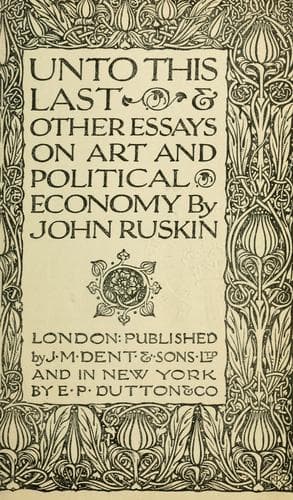
Unto This Last, and Other Essays on Political EconomyRuskin, John
General
Unto This Last, and Other Essays on Political Economy
Ruskin, John
Art; Economics
That, however, is not so. It would be so if the servant were an
engine of which the motive power was steam, magnetism, gravitation, or
any other agent of calculable force. But he being, on the contrary, an
engine whose motive power is a Soul, the force of this very peculiar
agent, as an unknown quantity, enters into all the political
economist's equations, without his knowledge, and falsifies every one
of their results. The largest quantity of work will not be done by
this curious engine for pay, or under pressure, or by help of any kind
of fuel which may be supplied by the chaldron. It will be done only
when the motive force, that is to say, the will or spirit of the
creature, is brought to its greatest strength by its own proper fuel;
namely, by the affections.
It may indeed happen, and does happen often, that if the master is a
man of sense and energy, a large quantity of material work may be done
under mechanical pressure, enforced by strong will and guided by wise
method; also it may happen, and does happen often, that if the master
is indolent and weak (however good-natured), a very small quantity of
work, and that bad, may be produced by the servant's undirected
strength, and contemptuous gratitude. But the universal law of the
matter is that, assuming any given quantity of energy and sense in
master and servant, the greatest material result obtainable by them
will be, not through antagonism to each other, but through affection
for each other; and that if the master, instead of endeavouring to get
as much work as possible from the servant, seeks rather to render his
appointed and necessary work beneficial to him, and to forward his
interests in all just and wholesome ways, the real amount of work
ultimately done, or of good rendered, by the person so cared for, will
indeed be the greatest possible.
Observe, I say, "of good rendered," for a servant's work is not
necessarily or always the best thing he can give his master. But good
of all kinds, whether in material service, in protective watchfulness
of his master's interest and credit, or in joyful readiness to seize
unexpected and irregular occasions of help.
Nor is this one whit less generally true because indulgence will be
frequently abused, and kindness met with ingratitude. For the servant
who, gently treated, is ungrateful, treated ungently, will be
revengeful; and the man who is dishonest to a liberal master will be
injurious to an unjust one.
Public-domain text, read in full here on John Shaqi.
Reviews
Reviews
No reviews yet
Be the first to share your thoughts on this work.
Elsewhere in the archive
Join the Discussion
Join the discussion
Sign in to leave a comment or review.
Sign InorCreate an account