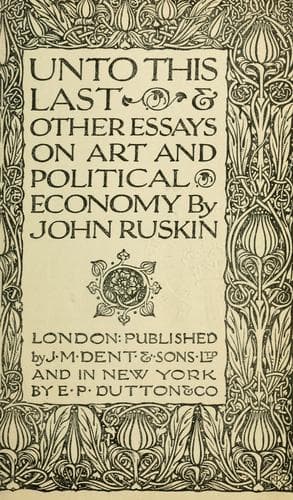
Unto This Last, and Other Essays on Political EconomyRuskin, John
General
Unto This Last, and Other Essays on Political Economy
Ruskin, John
Art; Economics
In any case, and with any person, this unselfish treatment will
produce the most effective return. Observe, I am here considering the
affections wholly as a motive power; not at all as things in
themselves desirable or noble, or in any other way abstractedly good.
I look at them simply as an anomalous force, rendering every one of
the ordinary political economist's calculations nugatory; while, even
if he desired to introduce this new element into his estimates, he has
no power of dealing with it; for the affections only become a true
motive power when they ignore every other motive and condition of
political economy. Treat the servant kindly, with the idea of turning
his gratitude to account, and you will get, as you deserve, no
gratitude, nor any value for your kindness; but treat him kindly
without any economical purpose, and all economical purposes will be
answered; in this, as in all other matters, whosoever will save his
life shall lose it, whoso loses it shall find it.[31]
[31] The difference between the two modes of treatment, and
between their effective material results, may be seen very
accurately by a comparison of the relations of Esther and
Charlie in _Bleak House_, with those of Miss Brass and the
Marchioness in _Master Humphrey's Clock_.
The essential value and truth of Dickens's writings have
been unwisely lost sight of by many thoughtful persons,
merely because he presents his truth with some colour of
caricature. Unwisely, because Dickens's caricature, though
often gross, is never mistaken. Allowing for his manner of
telling them, the things he tells us are always true. I wish
that he could think it right to limit his brilliant
exaggeration to works written only for public amusement; and
when he takes up a subject of high national importance, such
as that which he handled in _Hard Times_, that he would use
severer and more accurate analysis. The usefulness of that
work (to my mind, in several respects, the greatest he has
written) is with many persons seriously diminished because
Mr. Bounderby is a dramatic monster, instead of a
characteristic example of a worldly master; and Stephen
Blackpool a dramatic perfection, instead of a characteristic
example of an honest workman. But let us not lose the use of
Dickens's wit and insight, because he chooses to speak in a
circle of stage fire. He is entirely right in his main drift
and purpose in every book he has written; and all of them,
but especially _Hard Times_, should be studied with close
and earnest care by persons interested in social questions.
They will find much that is partial, and, because partial,
apparently unjust; but if they examine all the evidence on
the other side, which Dickens seems to overlook, it will
Public-domain text, read in full here on John Shaqi.
Reviews
Reviews
No reviews yet
Be the first to share your thoughts on this work.
Elsewhere in the archive
Join the Discussion
Join the discussion
Sign in to leave a comment or review.
Sign InorCreate an account