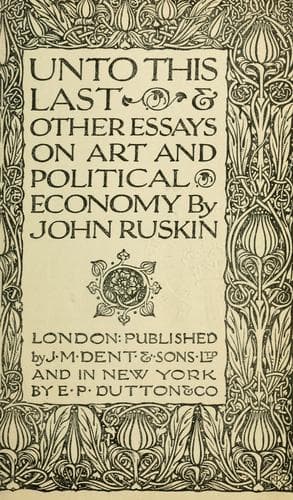
Unto This Last, and Other Essays on Political EconomyRuskin, John
General
Unto This Last, and Other Essays on Political Economy
Ruskin, John
Art; Economics
appear, after all their trouble, that his view was the
finally right one, grossly and sharply told.
The next clearest and simplest example of relation between master and
operative is that which exists between the commander of a regiment and
his men.
Supposing the officer only desires to apply the rules of discipline so
as, with least trouble to himself, to make the regiment most
effective, he will not be able, by any rules, or administration of
rules, on this selfish principle, to develop the full strength of his
subordinates. If a man of sense and firmness, he may, as in the former
instance, produce a better result than would be obtained by the
irregular kindness of a weak officer; but let the sense and firmness
be the same in both cases, and assuredly the officer who has the most
direct personal relations with his men, the most care for their
interests, and the most value for their lives, will develop their
effective strength, through their affection for his own person, and
trust in his character, to a degree wholly unattainable by other
means. The law applies still more stringently as the numbers concerned
are larger; a charge may often be successful, though the men dislike
their officers; a battle has rarely been won, unless they loved their
general.
Passing from these simple examples to the more complicated relations
existing between a manufacturer and his workmen, we are met first by
certain curious difficulties, resulting, apparently, from a harder and
colder state of moral elements. It is easy to imagine an enthusiastic
affection existing among soldiers for the colonel, not so easy to
imagine an enthusiastic affection among cotton-spinners for the
proprietor of the mill. A body of men associated for purposes of
robbery (as a Highland clan in ancient times) shall be animated by
perfect affection, and every member of it be ready to lay down his
life for the life of his chief. But a band of men associated for
purposes of legal production and accumulation is usually animated, it
appears, by no such emotions, and none of them are in anywise willing
to give his life for the life of his chief. Not only are we met by
this apparent anomaly, in moral matters, but by others connected with
it, in administration of system. For a servant or a soldier is
engaged at a definite rate of wages, for a definite period; but a
workman at a rate of wages variable according to the demand for
labour, and with the risk of being at any time thrown out of his
situation by chances of trade. Now, as, under these contingencies, no
action of the affections can take place, but only an explosive action
of _dis_affections, two points offer themselves for consideration in
the matter.
The first--How far the rate of wages may be so regulated as not to
vary with the demand for labour.
Public-domain text, read in full here on John Shaqi.
Reviews
Reviews
No reviews yet
Be the first to share your thoughts on this work.
Elsewhere in the archive
Join the Discussion
Join the discussion
Sign in to leave a comment or review.
Sign InorCreate an account