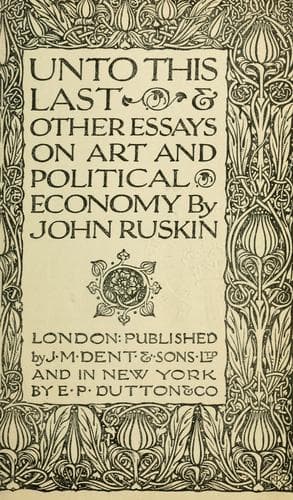
Unto This Last, and Other Essays on Political EconomyRuskin, John
General
Unto This Last, and Other Essays on Political Economy
Ruskin, John
Art; Economics
The second--How far it is possible that bodies of workmen may be
engaged and maintained at such fixed rate of wages (whatever the state
of trade may be), without enlarging or diminishing their number, so as
to give them permanent interest in the establishment with which they
are connected, like that of the domestic servants in an old family, or
an _esprit de corps_, like that of the soldiers in a crack regiment.
The first question is, I say, how far it may be possible to fix the
rate of wages irrespectively of the demand for labour.
Perhaps one of the most curious facts in the history of human error is
the denial by the common political economist of the possibility of
thus regulating wages; while, for all the important, and much of the
unimportant, labour on the earth, wages are already so regulated.
We do not sell our prime-ministership by Dutch auction; nor, on
the decease of a bishop, whatever may be the general advantages of
simony, do we (yet) offer his diocese to the clergyman who will
take the episcopacy at the lowest contract. We (with exquisite
sagacity of political economy!) do indeed sell commissions, but not,
openly, generalships: sick, we do not inquire for a physician who
takes less than a guinea; litigious, we never think of reducing
six-and-eightpence to four-and-sixpence; caught in a shower, we do not
canvass the cabmen, to find one who values his driving at less than a
sixpence a mile.
It is true that in all these cases there is, and in every conceivable
case there must be, ultimate reference to the presumed difficulty of
the work, or number of candidates for the office. If it were thought
that the labour necessary to make a good physician would be gone
through by a sufficient number of students with the prospect of only
half-guinea fees, public consent would soon withdraw the unnecessary
half-guinea. In this ultimate sense, the price of labour is indeed
always regulated by the demand for it; but so far as the practical and
immediate administration of the matter is regarded, the best labour
always has been, and is, as _all_ labour ought to be, paid by an
invariable standard.
"What!" the reader, perhaps, answers amazedly: "pay good and bad
workmen alike?"
Certainly. The difference between one prelate's sermons and his
successor's,--or between one physician's opinion and another's,--is
far greater, as respects the qualities of mind involved, and far more
important in result to you personally, than the difference between
good and bad laying of bricks (though that is greater than most people
suppose). Yet you pay with equal fee, contentedly, the good and bad
workmen upon your soul, and the good and bad workmen upon your body;
much more may you pay, contentedly, with equal fees, the good and bad
workmen upon your house.
Public-domain text, read in full here on John Shaqi.
Reviews
Reviews
No reviews yet
Be the first to share your thoughts on this work.
Elsewhere in the archive
Join the Discussion
Join the discussion
Sign in to leave a comment or review.
Sign InorCreate an account