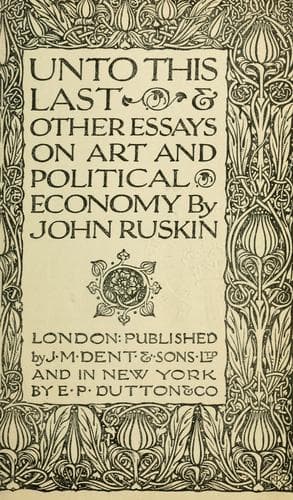
Unto This Last, and Other Essays on Political EconomyRuskin, John
General
Unto This Last, and Other Essays on Political Economy
Ruskin, John
Art; Economics
"Nay, but I choose my physician and (?) my clergyman, thus indicating
my sense of the quality of their work." By all means, also, choose
your bricklayer; that is the proper reward of the good workman, to be
"chosen." The natural and right system respecting all labour is, that
it should be paid at a fixed rate, but the good workman employed, and
the bad workmen unemployed. The false, unnatural, and destructive
system is, when the bad workman is allowed to offer his work at
half-price, and either take the place of the good, or force him by his
competition to work for an inadequate sum.
This equality of wages, then, being the first object towards which we
have to discover the directest available road; the second is, as above
stated, that of maintaining constant numbers of workmen in employment,
whatever may be the accidental demand for the article they produce.
I believe the sudden and extensive inequalities of demand which
necessarily arise in the mercantile operations of an active nation,
constitute the only essential difficulty which has to be overcome in a
just organization of labour. The subject opens into too many branches
to admit of being investigated in a paper of this kind; but the
following general facts bearing on it may be noted.
The wages which enable any workman to live are necessarily higher, if
his work is liable to intermission, than if it is assured and
continuous; and however severe the struggle for work may become, the
general law will always hold, that men must get more daily pay if, on
the average, they can only calculate on work three days a week, than
they would require if they were sure of work six days a week.
Supposing that a man cannot live on less than a shilling a day, his
seven shillings he must get, either for three days' violent work, or
six days' deliberate work. The tendency of all modern mercantile
operations is to throw both wages and trade into the form of a
lottery, and to make the workman's pay depend on intermittent
exertion, and the principal's profit on dexterously used chance.
Public-domain text, read in full here on John Shaqi.
Reviews
Reviews
No reviews yet
Be the first to share your thoughts on this work.
Elsewhere in the archive
Join the Discussion
Join the discussion
Sign in to leave a comment or review.
Sign InorCreate an account