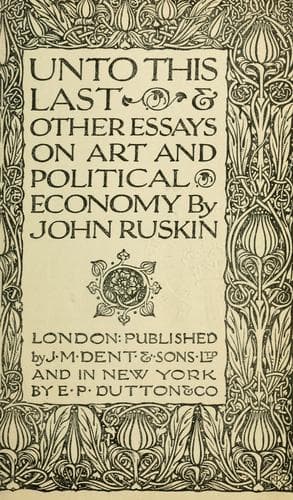
Unto This Last, and Other Essays on Political EconomyRuskin, John
General
Unto This Last, and Other Essays on Political Economy
Ruskin, John
Art; Economics
In what partial degree, I repeat, this may be necessary, in
consequence of the activities of modern trade, I do not here
investigate; contenting myself with the fact, that in its fatallest
aspects it is assuredly unnecessary, and results merely from love of
gambling on the part of the masters, and from ignorance and sensuality
in the men. The masters cannot bear to let any opportunity of gain
escape them, and frantically rush at every gap and breach in the walls
of Fortune, raging to be rich, and affronting, with impatient
covetousness, every risk of ruin; while the men prefer three days of
violent labour, and three days of drunkenness, to six days of moderate
work and wise rest. There is no way in which a principal, who really
desires to help his workmen, may do it more effectually than by
checking these disorderly habits both in himself and them; keeping his
own business operations on a scale which will enable him to pursue
them securely, not yielding to temptations of precarious gain; and, at
the same time, leading his workmen into regular habits of labour and
life, either by inducing them rather to take low wages in the form of
a fixed salary, than high wages, subject to the chance of their being
thrown out of work; or, if this be impossible, by discouraging the
system of violent exertion for nominally high day wages, and leading
the men to take lower pay for more regular labour.
In effecting any radical changes of this kind, doubtless there would
be great inconvenience and loss incurred by all the originators of
movement. That which can be done with perfect convenience and without
loss, is not always the thing that most needs to be done, or which we
are most imperatively required to do.
I have already alluded to the difference hitherto existing between
regiments of men associated for purposes of violence, and for
purposes of manufacture; in that the former appear capable of
self-sacrifice--the latter, not; which singular fact is the real
reason of the general lowness of estimate in which the profession of
commerce is held, as compared with that of arms. Philosophically, it
does not, at first sight, appear reasonable (many writers have
endeavoured to prove it unreasonable) that a peaceable and rational
person, whose trade is buying and selling, should be held in less
honour than an unpeaceable and often irrational person, whose trade is
slaying. Nevertheless, the consent of mankind has always, in spite of
the philosophers, given precedence to the soldier.
And this is right.
Public-domain text, read in full here on John Shaqi.
Reviews
Reviews
No reviews yet
Be the first to share your thoughts on this work.
Elsewhere in the archive
Join the Discussion
Join the discussion
Sign in to leave a comment or review.
Sign InorCreate an account