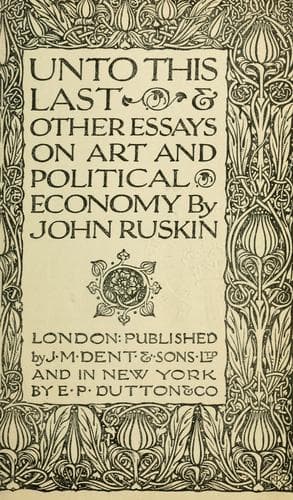
Unto This Last, and Other Essays on Political EconomyRuskin, John
General
Unto This Last, and Other Essays on Political Economy
Ruskin, John
Art; Economics
For the soldier's trade, verily and essentially, is not slaying, but
being slain. This, without well knowing its own meaning, the world
honours it for. A bravo's trade is slaying; but the world has never
respected bravos more than merchants: the reason it honours the
soldier is, because he holds his life at the service of the State.
Reckless he may be--fond of pleasure or of adventure--all kinds of
bye-motives and mean impulses may have determined the choice of his
profession, and may affect (to all appearance exclusively) his daily
conduct in it; but our estimate of him is based on this ultimate
fact--of which we are well assured--that, put him in a fortress
breach, with all the pleasures of the world behind him, and only
death and his duty in front of him, he will keep his face to the
front; and he knows that this choice may be put to him at any moment,
and has beforehand taken his part--virtually takes such part
continually--does, in reality, die daily.
Not less is the respect we pay to the lawyer and physician, founded
ultimately on their self-sacrifice. Whatever the learning or acuteness
of a great lawyer, our chief respect for him depends on our belief
that, set in a judge's seat, he will strive to judge justly, come of
it what may. Could we suppose that he would take bribes, and use his
acuteness and legal knowledge to give plausibility to iniquitous
decisions, no degree of intellect would win for him our respect.
Nothing will win it, short of our tacit conviction, that in all
important acts of his life justice is first with him; his own
interest, second.
In the case of a physician, the ground of the honour we render him is
clearer still. Whatever his science, we should shrink from him in
horror if we found him regard his patients merely as subjects to
experiment upon; much more, if we found that, receiving bribes from
persons interested in their deaths, he was using his best skill to
give poison in the mask of medicine.
Finally, the principle holds with utmost clearness as it respects
clergymen. No goodness of disposition will excuse want of science in a
physician, or of shrewdness in an advocate; but a clergyman, even
though his power of intellect be small, is respected on the presumed
ground of his unselfishness and serviceableness.
Now there can be no question but that the tact, foresight, decision,
and other mental powers, required for the successful management of a
large mercantile concern, if not such as could be compared with those
of a great lawyer, general, or divine, would at least match the
general conditions of mind required in the subordinate officers of a
ship, or of a regiment, or in the curate of a country parish. If,
therefore, all the efficient members of the so-called liberal
professions are still, somehow, in public estimate of honour,
preferred before the head of a commercial firm, the reason must lie
deeper than in the measurement of their several powers of mind.
Public-domain text, read in full here on John Shaqi.
Reviews
Reviews
No reviews yet
Be the first to share your thoughts on this work.
Elsewhere in the archive
Join the Discussion
Join the discussion
Sign in to leave a comment or review.
Sign InorCreate an account