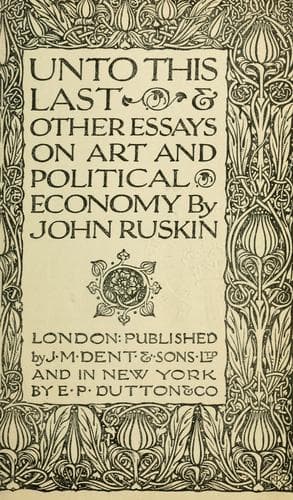
Unto This Last, and Other Essays on Political EconomyRuskin, John
General
Unto This Last, and Other Essays on Political Economy
Ruskin, John
Art; Economics
And the essential reason for such preference will be found to lie in
the fact that the merchant is presumed to act always selfishly. His
work may be very necessary to the community; but the motive of it is
understood to be wholly personal. The merchant's first object in all
his dealings must be (the public believe) to get as much for himself,
and leave as little to his neighbour (or customer) as possible.
Enforcing this upon him, by political statute, as the necessary
principle of his action; recommending it to him on all occasions, and
themselves reciprocally adopting it; proclaiming vociferously, for law
of the universe, that a buyer's function is to cheapen, and a seller's
to cheat,--the public, nevertheless, involuntarily condemn the man of
commerce for his compliance with their own statement, and stamp him
for ever as belonging to an inferior grade of human personality.
This they will find, eventually, they must give up doing. They must
not cease to condemn selfishness; but they will have to discover a
kind of commerce which is not exclusively selfish. Or, rather, they
will have to discover that there never was, or can be, any other kind
of commerce; that this which they have called commerce was not
commerce at all, but cozening; and that a true merchant differs as
much from a merchant according to laws of modern political economy, as
the hero of the _Excursion_ from Autolycus. They will find that
commerce is an occupation which gentlemen will every day see more need
to engage in, rather than in the businesses of talking to men, or
slaying them; that, in true commerce, as in true preaching, or true
fighting, it is necessary to admit the idea of occasional voluntary
loss; that sixpences have to be lost, as well as lives, under a sense
of duty; that the market may have its martyrdoms as well as the
pulpit; and trade its heroisms, as well as war.
May have--in the final issue, must have--and only has not had yet,
because men of heroic temper have always been misguided in their youth
into other fields, not recognizing what is in our days, perhaps, the
most important of all fields; so that, while many a zealous person
loses his life in trying to teach the form of a gospel, very few will
lose a hundred pounds in showing the practice of one.
The fact is, that people never have had clearly explained to them the
true functions of a merchant with respect to other people. I should
like the reader to be very clear about this.
Five great intellectual professions, relating to daily necessities
of life, have hitherto existed--three exist necessarily, in every
civilized nation:
The Soldier's profession is to _defend_ it.
The Pastor's, to _teach_ it.
The Physician's, to _keep it in health_.
The Lawyer's, to _enforce justice_ in it.
The Merchant's, _to provide_ for it.
And the duty of all these men is, on due occasion, to _die_ for it.
"On due occasion," namely:--
The Soldier, rather than leave his post in battle.
Public-domain text, read in full here on John Shaqi.
Reviews
Reviews
No reviews yet
Be the first to share your thoughts on this work.
Elsewhere in the archive
Join the Discussion
Join the discussion
Sign in to leave a comment or review.
Sign InorCreate an account